My Slaveholding Ancestor, Part VIII

During the 19th century, almost all of my ancestors lived either in or adjacent to the “Quaker Belt” of the central piedmont of North Carolina. Quakers, Moravians, and Wesleyan Methodists dominated the religious landscape of that region of the Old North State. My great-great-great-grandfather Daniel Hackney, Jr., lived in Chatham County on the eastern side of that region. He enslaved 14 human beings and had been a pro-slavery Unionist as a member of the General Assembly of North Carolina during the 1840s and 1850s. He retained his political identity as “a constitutional Union man” until President Lincoln requested troops to suppress the rebellion in South Carolina and the rest of the Lower South. Hackney and most of the conservative, pro-slavery Unionists in North Carolina, then became reluctant supporters of secession, which became a reality on May 20, 1861. Hackney served as an officer in the Home Guard.

Even before secession was official, Hackney joined others for a “grand rally” on May 18, 1861, to raise up volunteers in Chatham County for what would become Company E, 26th Regiment, North Carolina Infantry. Here’s how that event was described in a historical sketch written sometime before March, 1863, and republished in the Chatham Record newspaper in Pittsboro, North Carolina, on September 15, 1915:

The day came and with it a large assembly of gentlemen and ladies anxious to join the company or to persuade the hesitating to do so. Speeches were made by William P. Taylor, S.S. Carter, Daniel Hackney, and William G. Headen, encouraging the young men to rally to the call of their country and take up arms against the usurpations of a tyrant as their ancestors did in the memorable struggle of 1776.

In the western half of the Quaker Belt, however, my ancestors in Forsyth County and some of the counties that surrounded it were less enthusiastic about the political situation that had emerged. More of my ancestors are buried in God’s Acre, which is how Moravians from Germany referred to their graveyards, at Friedland Moravian Church in Forsyth County than anywhere else. Five of them belonged to the Friedland Society when it was created in 1771. Another, Tycho Nissen, became its first pastor in 1775, although he’s described as an “Akoluthe,” or non-ordained minister, who led them until they became a congregation in 1780. Nissan moved to Salem in the same county and worked as the gravedigger and headstone engraver for the Salem Congregation (Moravian) and later became the night watchman too.

Friedland Moravian Church shaped the faith of my great-great-grandfather David Williard, his six brothers, and his four sisters. Interestingly, David Williard was born on the Fourth of July, 1823 (exactly 47 years after the signing of the Declaration of Independence). Later in adulthood, he and at least three of his siblings would become members of Primitive Baptist churches. But they all began as Moravians.

All seven Williard brothers fell within the age range that made them subject to America’s first general military draft (i.e., conscription), enacted by the First Congress of the Confederate States of America in the spring of 1862 and expanded in the fall of 1862. Governor Zebulon B. Vance, defending the rights of North Carolina, objected strenuously to this law that seemed to contradict a major principle of the rebellion. The Federal government followed suit with a national conscription act in 1863, resulting in draft riots and racial violence that same year in New York City.

The expansion of the Confederate conscription law in the fall of 1862 not only extended the age range for enrollment but also allowed an exemption from the draft for one slaveholder or one overseer on each plantation that had 20 or more able-bodied enslaved individuals. In North Carolina, that provision applied to the elite planter class, to which my great-great-great-grandfather Daniel Hackney, Jr., didn’t even belong with 14 enslaved people.

One can easily imagine how that made the yeoman farmers of the central piedmont feel. Owning either few or no slaves, their religious convictions did not naturally support pro-slavery opinions (which is not to say that most of them were “radical” abolitionists). Some of them became reluctant secessionists like Hackney after President Lincoln’s call for troops. However, many were either passively or actively resistant to a war that would be fought by the poor for the benefit of the rich.

David Williard, the oldest of the brothers, and William Williard, the youngest, were both privates in Company A, 10th Battalion, North Carolina Heavy Artillery. Alvarius and Joseph Williard were both privates in Company K, 21st Regiment, North Carolina Infantry. Yancey and Jacob Williard were both privates in Company A, 42nd Regiment, North Carolina Infantry. I’m not sure how the seventh brother, Pinkney Williard, was affected by the draft. He might have evaded it, had a medical condition, or served under a different first name. Certain occupations were exempt, but not farmers like him.

Like many conscripts from North Carolina, Joseph Williard deserted on December 26, 1864, with “one gun & accoutrements” valued at $65.23. Yancey Williard deserted in the summer of 1864, but he returned in September under an amnesty program by the Governor of North Carolina.

In spite of that, Yancey Williard seems to be my only relative whose headstone has Confederate references, with the name of his military unit and an engraving of the Confederate battle flag, which would become infamous in the 1960s as a symbol of white supremacist ideology and opposition to racial desegregation.

Yancey Williard’s name appears in a list of soldiers that was published in the Daily Conservative newspaper in Raleigh, North Carolina, on January 20, 1865. It was to inform their loved ones that their company had been captured during the First Battle of Fort Fisher near Wilmington, North Carolina. To be more precise, finding themselves outgunned by the Union navy and separated from the rest of their regiment, they surrendered to Union forces under a white flag of truce on the afternoon of Sunday, December 25, 1864. Earlier, during the stillness before sunrise on that Christmas Day, a surgeon aboard the Union vessel Ben de Ford named David W. Hodgekins wrote these grief-laden words:

How sadly we have fallen that the anniversary of the day of the birth of Jesus Christ, who came to declare peace on earth and good will to men, should be spent in endeavors to take the lives of our fellow creatures in war. The Sabbath we are commanded to keep holy [is] desecrated to gratify men’s wild ambitions. [That we wage war on] this Sabbath . . . seems more than desecration.
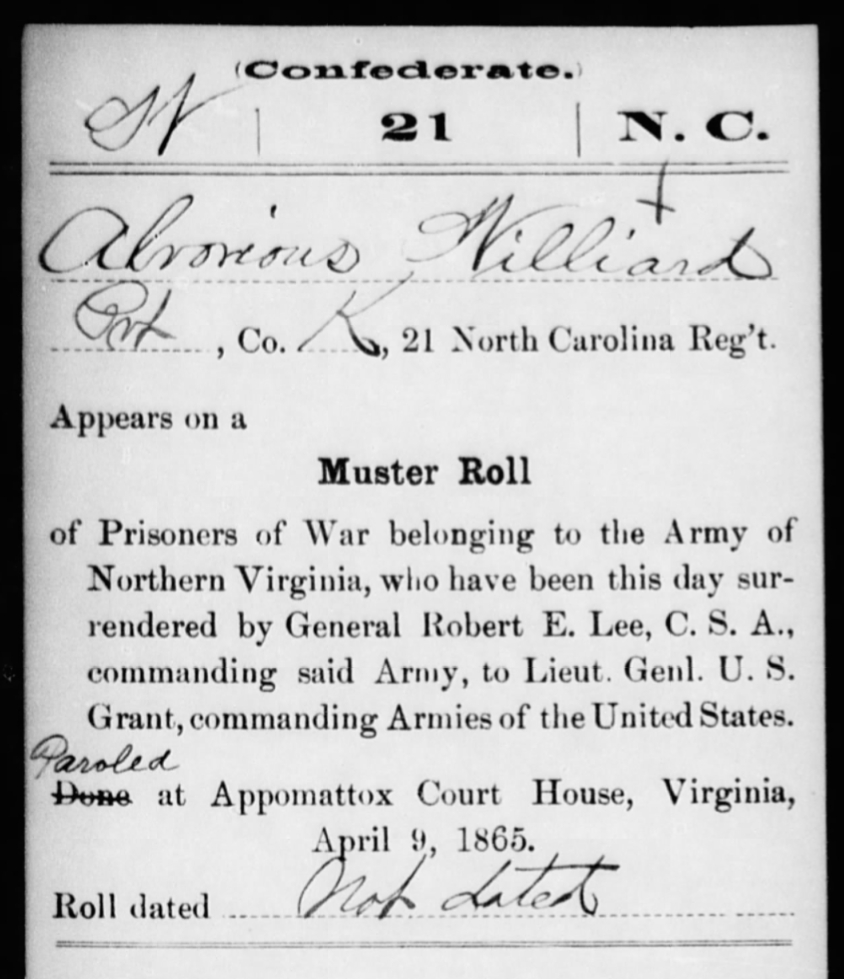
The other four Williard privates seem to have endured longer, although two of them were sick for long periods of time during 1864. David Williard suffered from chronic dysentery for at least six months, while Jacob Williard spent at least nine months in various military hospitals. But it was Alvarius Williard who would become a witness to history at Appomattox Court House in Virginia on April 9, 1865, when the Army of Northern Virginia was surrendered by General Robert E. Lee.

I’ll never be able to know the degree to which these Williards were relieved that the fighting into which they had been pressed came to an end. I’d like to think at least a few of them were kindred spirits with other individuals from the Quaker Belt who were drafted, served, and remained Unionists in their hearts under circumstances beyond their control. I do know, however, that these Williards had cousins who resisted the rebellion actively on the homefront, which will be the subject of my next reflection in this series because the choices they made stand in direct opposition to the choices of my great-great-great-grandfather Daniel Hackney, Jr.

Had those cousins lived in the same county as Hackney, 3rd lieutenant in Chatham County’s Home Guard, they might have killed each other. Each one would have been viewed as a patriot or a terrorist, depending on who would have described them.

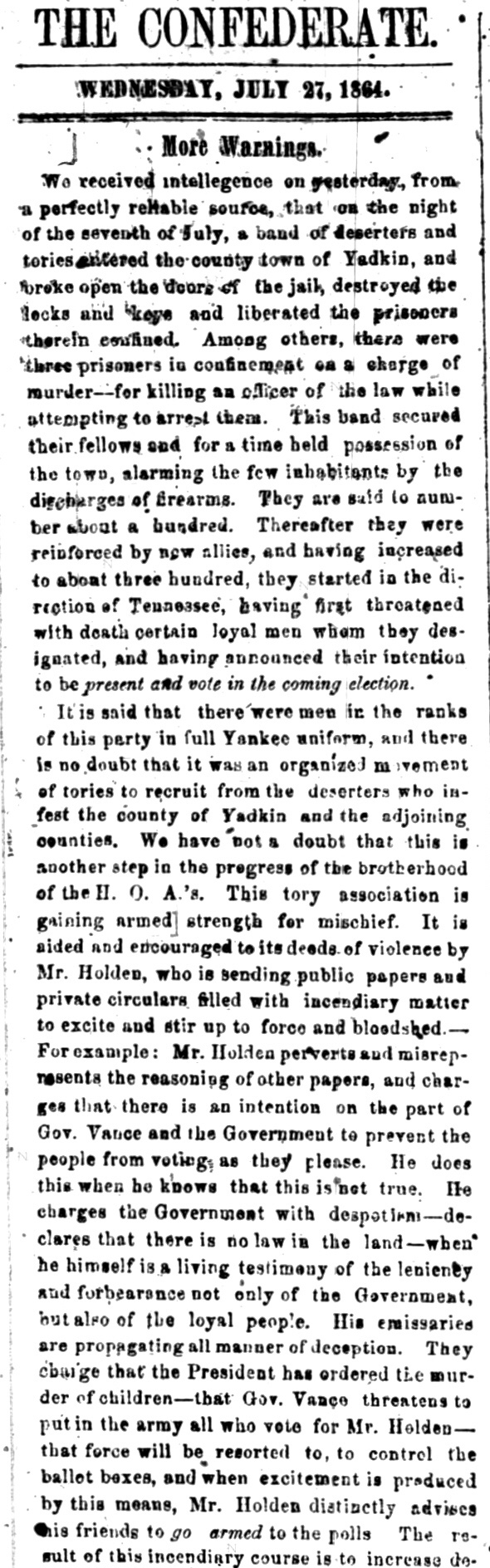
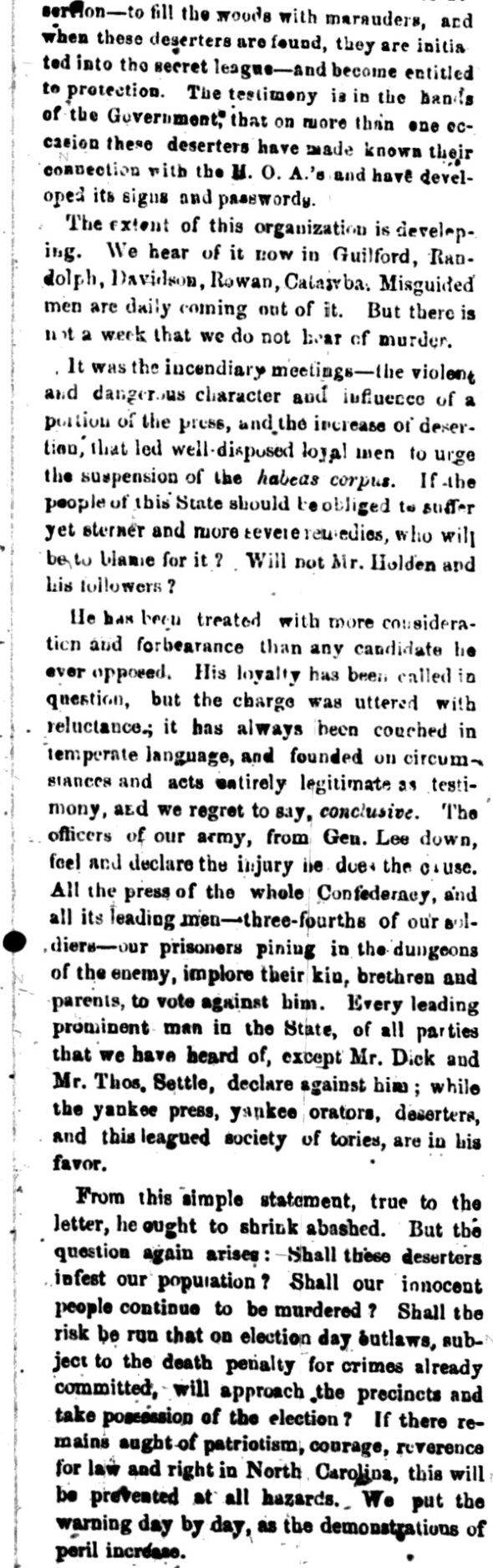
The following editorial that was published in the Weekly Confederate newspaper in Raleigh on July 27, 1864, refers to those cousins and others as tories, outlaws, deserters, and murderers. The cousins were among those who had been arrested “for killing an officer of the law,” those who broke them out of jail, and those who tried to reach Union territory in Tennessee. The editorial also decries the political opinions of William Holden, who was the editor of the North Carolina Standard newspaper in Raleigh and would run unsuccessfully as a “peace candidate” against Governor Zebulon Vance in 1864. Lastly, it connects the actions of those cousins and others with a secret brotherhood known as the H.O.A. or Heroes of America. That sounds completely made up, but it was a real organization that worked hard against the Confederate government’s activities in North Carolina. While I don’t know if those cousins of mine belonged to the H.O.A., this editorial testifies to the fear its name invoked:
Click here to read all of the reflections in this series.

My Slaveholding Ancestor, Part VII

Even before a convention of the people of North Carolina passed an ordinance of secession on the first day that it convened, May 20, 1861, preparations were being made for war. In the previous month, for example, the Governor of North Carolina had ordered the seizure of all Federal property in the state. The General Assembly, on May 2, 1861, made it illegal to administer to state officials “any oath or affirmation to support the constitution of the United States.” And on April 29, 1861, my great-great-great-grandfather Daniel Hackney, Jr., was asked to chair a meeting for the purpose of establishing a “Home Guard” for Chatham County, where he lived. His report about that and another meeting several days later was published on May 22, 1861, in the same issue of Raleigh’s State Journal newspaper that announced the passage of secession.

Hackney and three others were appointed to visit Raleigh for a conversation with the governor about this company, which was being formed by those too old for or legally excused from service in “the regular army.” Hackney was elected 3rd lieutenant of the company, and together with the others:

The company pledged themselves, by resolution, to protect the peace and security of the District, and to look to the interest of those who may volunteer in the service of their country, and especially to take care of their wives and children. . . . The company by resolutions, pledged their services, their fortunes, their honors, and their lives to protect the institutions, and the civil and religious freedom of their native land.

On the same page of the State Journal that Hackney’s report appeared, there was a summary of a report from the Southern Baptist Convention. The newspaper noted the importance of that document, which “approves of the Southern Confederacy,”  as “an expression of sentiment from the largest religious denomination in the country.” It goes on to state that “[the report] will form a bright spot in their history, and be an honor to them for all generations to come.” But that was a false prophecy.

The Southern Baptist Convention had been formed in 1845 when white Baptists in the South withdrew fellowship from Baptists in the North after a slave-owner had been forbidden from becoming a missionary. 150 years later, the “messengers” of the Southern Baptist Convention, assembled in Atlanta, Georgia, acknowledged that historical reality, apologized for their failure to support the 1960s Civil Rights Movement, and stated that they “lament and repudiate historic acts of evil such as slavery from which we continue to reap a bitter harvest, and . . . recognize that the racism which yet plagues our culture today is inextricably tied to the past.”

Similar tensions and strained relationships emerged in other traditions too.

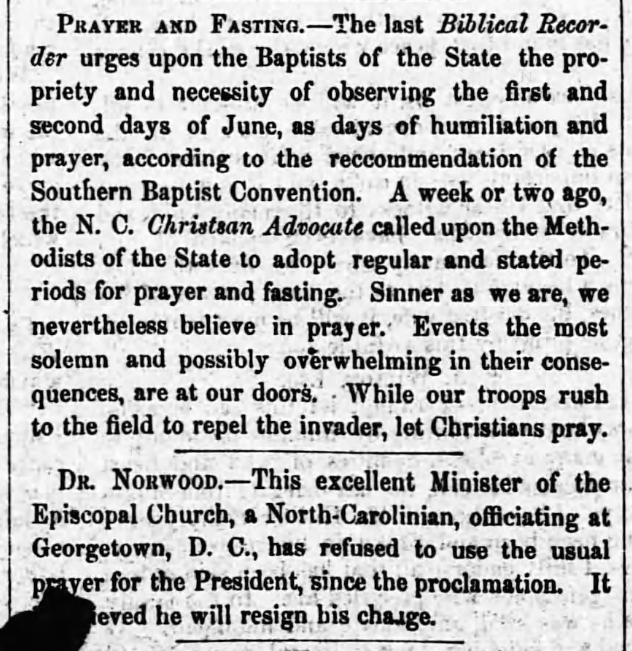
As noted in the May 29, 1861, issue of the North Carolina Standard newspaper, the Rev. Dr. William Norwood, Rector of Christ Church (Episcopal) in Georgetown in the District of Columbia, refused to allow the prayer for “the President of the United States and all in Civil Authority” to be read in worship for his congregation. Like the rest of his colleagues, Dr. Norwood, a native North Carolinian, had received explicit instructions from his bishop to continue to use that prayer and been warned that failure to do so would be in “willful violation of his ordination vow.” Later that same year, he resigned as the Rector of Christ Church and moved to Richmond, Virginia.

Even the Moravians in North Carolina, who were collectively and culturally further removed from the centers of power than both Southern Baptists and Episcopalians, wrestled with politics and prayer. The records of the Board of Elders for the Salem Congregation (Moravian) in Salem (now Winston-Salem) include this description of a discussion on April 17, 1861, about praying for the President of the United States:

The prayer for the President and the Union in our litany was spoken of. For a considerable time it was prayed every Sunday, and its repeated omission of late has been remarked upon. The Board did not come to a determination whether or not it should be regularly used under the circumstances.

Like Salem, Bethania was another Moravian town in North Carolina. And like other ordained ministers in this Christian tradition with German roots, the pastor of the Bethania congregation kept detailed church records, including a congregational diary. The Rev. Jacob F. Siewers’ last entry in that diary for 1860 refers to a worship service on January 31 with lots of hymn singing and a simple meal together called a lovefeast. It was a custom to gather in the church on New Year’s Eve for that service in order to enter the New Year with prayer. He concludes the entry with his own prayer, which is a heartbreaking plea to God for mercy in the coming storm of 1861:

Cloudy and miserable under foot. . . . About 8 P.M. we had the lovefeast at Bethania; there were several pieces sung by the choir. In spite of the high water and miserable roads there was quite a number in attendance. . . . After 12 a prayer was offered, and the Text of New Year’s Day read. Thus closed this eventful year, with heavy clouds lowering around the destiny of our Beloved Country. May God, our God in Mercy spare us from the fearful results of Disunion and Civil War, and cement us again in peaceful Brotherhood, and Christian Bonds as a nation.

The storm of violence, of course, did eventually appear on the horizon, beginning with the first major battle of the Civil War in Virginia in July of that New Year. What it revealed, however, were not only divisions between North and South but also between the Confederate government of North Carolina and the administration of Jefferson Davis, President of the Confederate States of America, and between North Carolinians loyal to that Confederate government in Raleigh and those who resisted it to protect their loved ones and their livelihoods.

That tension between citizens left behind in their communities and the Home Guard, which supposedly existed to protect them, was very high in the “Quaker Belt” of the central piedmont, where Quakers, Moravians, and Wesleyan Methodists dominated the religious landscape, where I was raised, and where most of my ancestors lived in the Old North State.

And they lived on both sides of that divide. While my great-great-great-grandfather served as an officer in the Home Guard for Chatham County, I have other ancestors who were born to Moravian parents in Forsyth County and were drafted as enlisted soldiers in “the regular army.”  But there are clues this was not their war, and their cousins would take that disaffection with rebellion to another level of resistance.

Click here to read all of the reflections in this series.

My Slaveholding Ancestor, Part VI

On April 12, 1861, South Carolina artillery fired on Fort Sumter, which was surrendered the next day. On April 15, 1861, President Abraham Lincoln asked for 75,000 troops collectively from states that remained loyal to the Union to suppress the rebellion. The Governor of North Carolina, John Ellis, refused to send any troops for what he envisioned as a military invasion. In his response to the U.S. Secretary of War, Governor Ellis described the President’s request as a “violation of the Constitution and a gross usurpation of power.” On April 17, 1861, he issued his own proclamation, calling for the General Assembly of North Carolina to meet in a special session on May 1, 1861, for the purpose of  “[united] action in defense of the sovereignty of North Carolina.” Governor Ellis also ordered the seizure of all Federal property in the state.

On the first day of that special session, legislation was passed to hold an election on May 13, 1861, to select 120 delegates to a convention of the people of North Carolina. Unlike the earlier vote in March, this was not about whether to hold a convention but only about whom to send. The General Assembly had already made the decision on behalf of the people that the convention would meet in Raleigh on May 20, 1861. Furthermore, there would be no restrictions on its scope and no popular referendum on its decisions. The mistakes of the past wouldn’t be repeated this time.

Above and to the right is a partial list of counties in North Carolina and the delegates from those counties who were elected to serve at that convention. The list was published in Raleigh on the front page of the North Carolina Standard newspaper on May 22, 1861. In several places, the names of the entire slate are given along with the actual vote count, including the results from Chatham County.

That’s where my great-great-great-grandfather Daniel Hackney, Jr., a former state politician and an enslaver of 14 human beings, lived. Note that his name appears on the list of eight candidates in Chatham County. Three of those candidates were elected as delegates. Hackney came in sixth. Also on the front page that day was a defense of “the old Union men,” like Hackney, “who exhausted all honorable means to save the Union.”

The delegates who were elected to that convention enslaved an average of 30.5 people each and came with opinions that had been shaped by the President’s request for troops. More than half of them belonged to the elite planter class based on the total number of people they enslaved. The convention voted unanimously to secede from the Union on the first day it convened, May 20, 1861. But that is not to say that everyone in the room was equally enthusiastic about that decision. The editor of the North Carolina Standard was there as a delegate and later recalled the scene in this way:

I remember well that when the act of Secession was consummated the body looked like a sea, partly in storm, partly calm, the Secessionists shouting and throwing up their hats and rejoicing, and the Conservatives sitting quietly, calm, and depressed.

My great-great-great-grandfather would have been in the latter group if he had been elected as a delegate. But it’s important to remember the embarrassing truth that he and most of the other slaveholding, pro-slavery Unionists were only reluctant secessionists because they believed it would eventually lead to the destruction of the institution of slavery. They, of course, were right about that. Yet they would not remain in the Union if it required them to bear arms against South Carolinians.

One of those Unionists-turned-secessionists was Zebulon Vance, who would later become the wartime Governor of North Carolina. In some of his correspondence before he had concluded his term as a U.S. Representative, he wrote that it would be suicidal for North Carolina and the other states of the Upper South (i.e., Delaware, Kentucky, Tennessee, Maryland, Virginia, Arkansas, and Missouri) to join forces with the Lower South. Nevertheless, that’s exactly what half of them did. Listed in order of secession, those four states were Virginia, Arkansas, Tennessee, and North Carolina.[1] Zeb Vance’s private fears, shared by many, would prove to be prophetic.

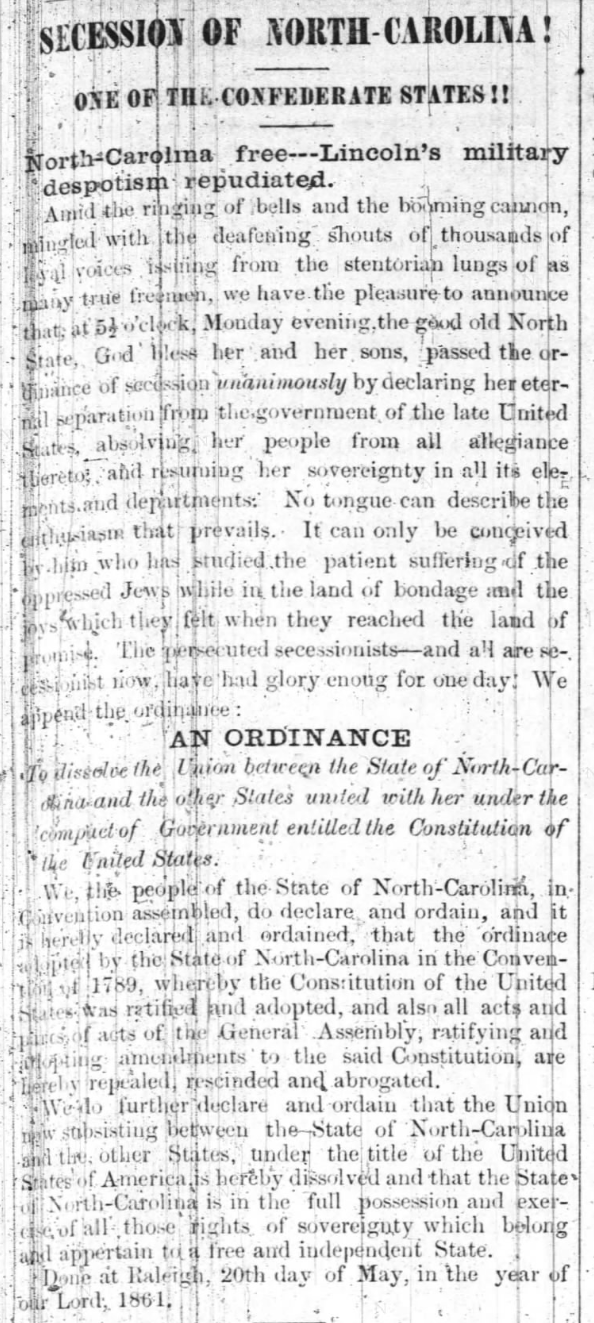
This is how secession was announced in Raleigh’s State Journal newspaper on May 22, 1861, including a sick and twisted use of the biblical story of the Exodus (i.e., the suffering of the children of Israel in bondage in Egypt, their deliverance by the hand of God, and their arrival in the Promised Land) to describe the imagined suffering of secessionists and their liberation in this moment. There is no mention, of course, of the enslaved Africans who were actually in bondage and comprised 33% of the total population of North Carolina, according to the 1860 United States Federal Census:

Click here to read all of the reflections in this series.

BACK TO POST Yes, I am aware of the debate over different ways to order this list. North Carolina had the last state convention to pass an ordinance of secession on May 20, 1861, while the earlier ordinances passed in Virginia and Tennessee were ratified by popular referendums in each of those states on May 23 and June 8, 1861, respectively.

My Slaveholding Ancestor, Part V

On February 28, 1861, there was a state-wide referendum in North Carolina on whether to hold a secession convention and, in the event it was held, the election of delegates for that convention. This was a limited poll, of course, in which the only voters were white male taxpayers.

At the end of the day, those particular men narrowly defeated secessionism by a vote of 47,323 to 46,672. Unionist support, however, was actually stronger than those numbers suggest. That’s because there were also Unionists who voted in favor of holding that convention for the purpose of sending Unionist delegates there to control it. Out of 120 total seats at the convention, Unionist delegates would have had about 80 of them. Most of these Unionists were like my great-great-great-grandfather Daniel Hackney, Jr., who was an as-it-was-with-slavery Unionist, not an as-it-might-be-without-slavery Unionist. The North Carolina Standard newspaper described Hackney, a former state politician, as “a constitutional Union man” in a report about a Union meeting that was held in Chatham County on December 27, 1860.

The ten counties listed above and to the right are part of the election results that were published in the North Carolina Standard on March 6, 1861. Chatham County, where Hackney lived, elected three Unionist delegates and overwhelmingly opposed holding a convention by a vote of 1795-283. (“Chatham has covered herself with glory.”) Forsyth County, where I was raised, elected two Unionist delegates who ran unopposed and overwhelmingly rejected the convention too. Alamance County, where my mother grew up, also elected two Unionist delegates and voted down the convention. (“Three cheers for Alamance for electing straight out Union delegates!”) And the same story was repeated in Guilford County, where my father was raised, with the election of three Unionist delegates, 2771 votes against holding a convention, and only 113 votes for it. Five of those counties are in the “Quaker Belt” of the central piedmont, where Quakers, Moravians, and Wesleyan Methodists would provide fertile soil for disaffection with a pro-slavery rebellion to take root.

Some of the other counties listed there, where the convention vote was much closer, are further east, near the coast. Generally speaking, that tracked with popular support for secession across the Old North State, with less enthusiasm the further west one traveled (i.e., toward the Blue Ridge Mountains) and more enthusiasm the further east one traveled (i.e., toward the “inner banks” along the coastal sounds).

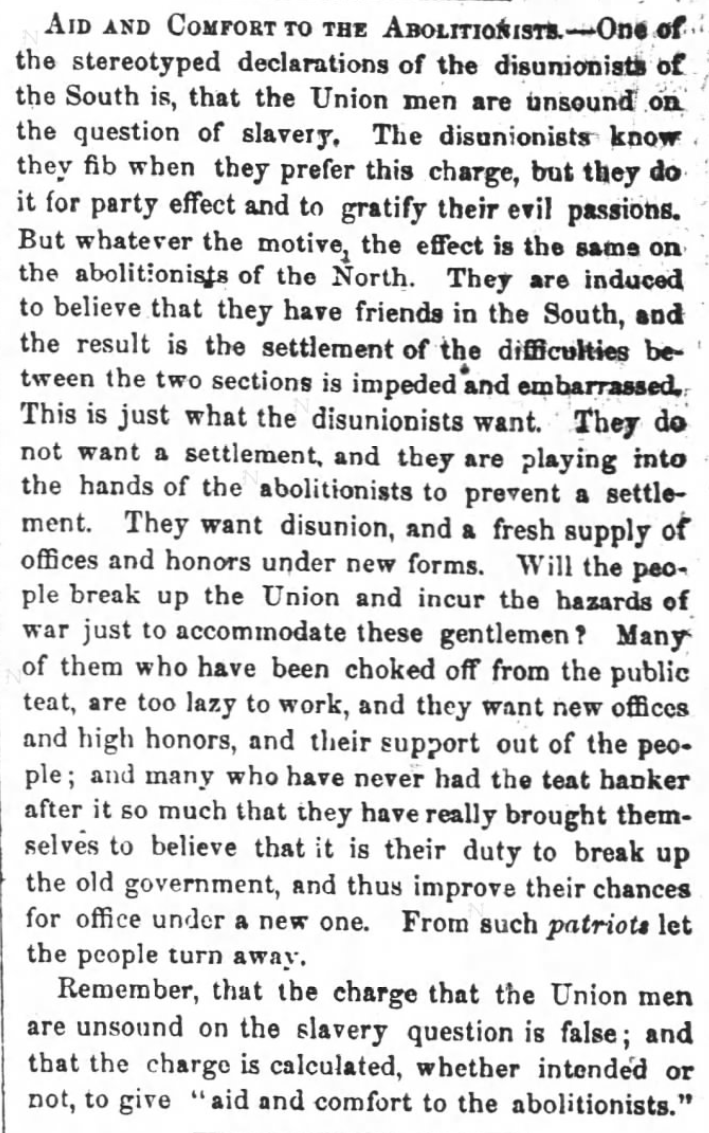
This pro-Union verse, sung to the tune of Dixie’s Land, was published in the North Carolina Standard on February 6, 1861. It reflects a mood that remained popular as late as April 3, 1861, when the following editorial appeared in the same newspaper, together with other reminders that “the disunionists were voted down on the 28th of February” and that Unionists like my great-great-great-grandfather were “not unsound on the question of slavery.” Alas, “not unsound” here means pro-slavery:

North Carolina will not secede from the Union for existing causes. Nearly all the Union candidates in this State advocated a Convention; if they had opposed it, it would have been voted down by 30,000 majority. We state this as one of the strongest evidences that the State is not disposed at this time to secede. It will not do to say that the people of North Carolina are submissionists. They are just as brave as other people, and because they are, they are not ready to fight shadows. . . .

We repeat, North Carolina will not secede. Virginia will not secede. The late action of her Convention shows that she is watching and waiting. She sees no good cause just now to join the war dance of secession. Our disunion friends may as well hang up their fiddles. The people will keep step to no tune of their playing.

Nine days after those words were published, on April 12, 1861, South Carolina batteries opened fire on the Federal garrison at Fort Sumter in Charleston Harbor. The fort was surrendered the next day. Then, on April 15, 1861,  President Abraham Lincoln issued a proclamation asking for 75,000 troops collectively from the states that remained loyal to the Union for the purpose of suppressing this rebellion by South Carolina and the other states of the Lower South. Listed in order of secession, those six states were Mississippi, Florida, Alabama, Georgia, Louisiana, and Texas.

Click here to read all of the reflections in this series.

My Slaveholding Ancestor, Part IV

My great-great-great-grandfather Daniel Hackney, Jr., was first elected to the House of Commons in North Carolina’s General Assembly in 1844 as a member of the Whig Party from Chatham County. He served four two-year terms in a row, through 1851. After the dissolution of the Whig Party in the 1850s, he became a Democrat and ran for the same office in the same county on the anti-Know Nothing ticket in 1856. He served one two-year term with that new political identity. One letter to the editor in The North Carolina Standard newspaper, referring to Hackney’s opinions about the 1856 presidential election, claimed that he believed old-line Whigs and Democrats “ought to unite now to save the country by sustaining that candidate who would most probably beat the black Republican ticket.”

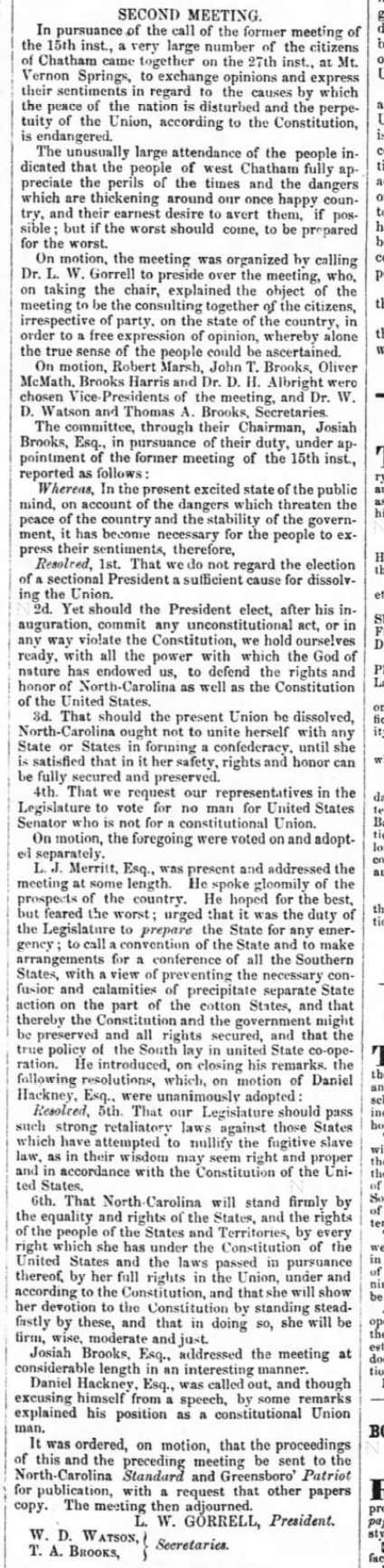
“Black Republican” was a disparaging term used to highlight the anti-slavery views of the Republican Party, which had only been formed two years earlier in 1854. The two-part article on the right from The North Carolina Standard newspaper describes a Union meeting that convened in Chatham County on December 15, 1860, and then again on December 27, 1860.

Many of the people who attended similar meetings in the Old North State were like Hackney. He was an as-it-was-with-slavery Unionist rather than an as-it-might-be-without-slavery Unionist. They believed the best path for protecting the institution of slavery was to stay in the Union, and that secession would likely result in slavery’s destruction. Although Hackney no longer held a seat in the General Assembly and didn’t make a formal speech at either of these meetings in Chatham County, he “was called out” to offer some remarks at the second gathering with the larger crowd and “explained his position as a constitutional Union man.”

The resolutions that were passed at that second meeting include a lot of highly qualified language. There is much concern expressed at the end about equal rights, not for individuals but for states. While the perception that states’ rights were being trampled upon fueled these debates, the fifth resolve hints at the real source of the anxiety: “That our Legislature should pass such strong retaliatory laws against those States which have attempted to nullify the fugitive slave laws, as in their wisdom may seem right and proper and in accordance with the Constitution of the United States.”

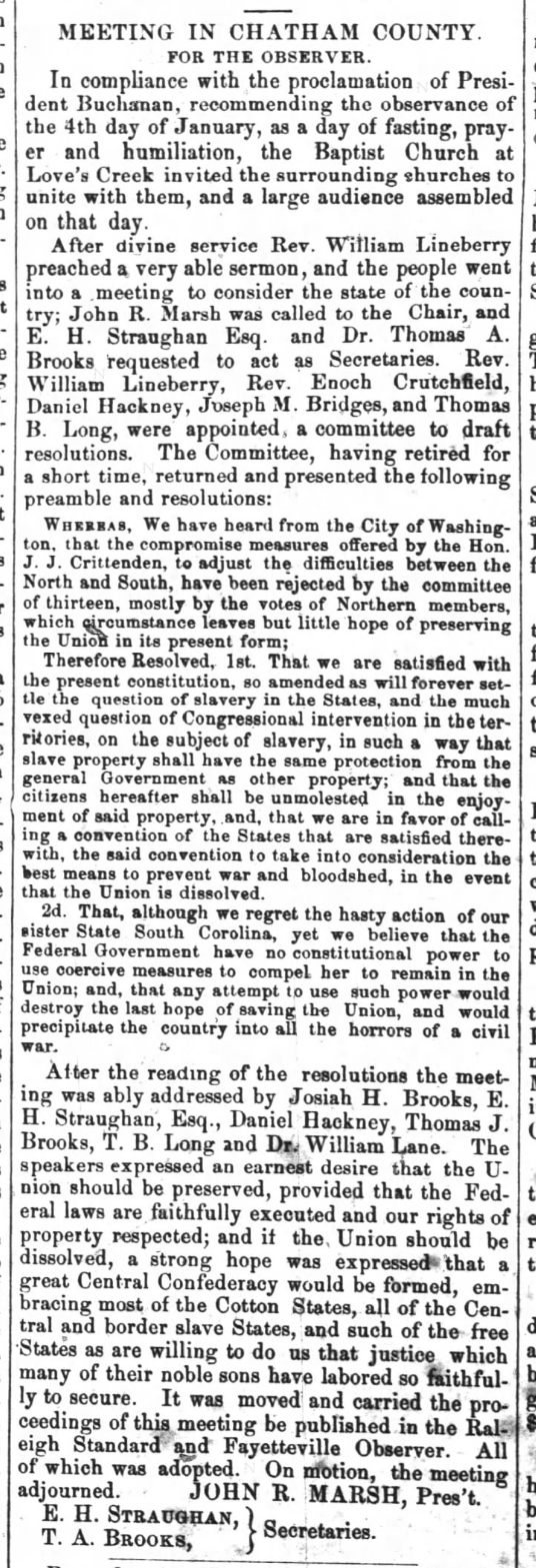
That becomes even clearer on January 4, 1861, at a meeting in Chatham County that was initially convened in response to President James Buchanan’s call for “a day of fasting, prayer and humiliation.” The President intended that as a way to calm the storm of unrest in the North and in the South following South Carolina’s ordinance of secession, which was adopted on December 20, 1860.

The meeting took place at Love’s Creek Baptist Church, where Hackney had served as a deacon long before he was first elected to public office. After the prayer service, Hackney, two ordained ministers, and two other men “were appointed a committee to draft resolutions.” The Fayetteville Observer newspaper noted that their work didn’t take very long:

Although Hackney and others spoke of their desire to preserve the Union, that was only true “provided that the Federal laws are faithfully executed and [their] rights of property respected.” As the first resolve plainly states, that property included enslaved human beings, and the will of the people gathered inside that Baptist church was that “citizens hereafter shall be unmolested in the enjoyment of said property.” My great-great-great-grandfather enslaved 14 people at the time he helped to write those words. That is a difficult but necessary truth to acknowledge. This really happened, and despite all of the rhetoric about states’ rights as the primary Southern issue, protecting the institution of slavery was the motive behind it.

North Carolina did not secede from the Union until May 20, 1861. The larger political story that led to that, including what happened on the ground in Chatham County, warrants its own reflection. It’s a story that’s not as simple as one might imagine it to be.

Unionists, both pro-slavery and not pro-slavery, won a state-wide victory in February of 1861 that, ironically, almost certainly aided the secessionist movement in the long run. Those on the losing side would make sure that next time there would be no popular referendum about whether to hold a secession convention and no popular referendum on its decision. When secession did become a reality, most “conservative” pro-slavery Unionists like my great-great-great-grandfather didn’t resist it. They joined it.

Click here to read all of the reflections in this series.

My Slaveholding Ancestor, Part III

I’m a native of the Old North State and received my undergraduate degree in religion from Wake Forest University in Winston-Salem, North Carolina, which is not too far from the town of Kernersville where I was raised. My next adventure was in New Haven, Connecticut, at Yale Divinity School, as I prepared myself for ordination in the Episcopal Church. Other than a semester overseas in London and a summer of archeology in Israel, it was the first time that I had ever lived outside the South.

Those of us seeking ordination spent at least one year working at a field placement during our three years of theological studies. That was usually a church where we would help out a couple of times a week. Only a few of my peers drove further away from New Haven to get to their field placement than I did. Mine was a West Indian, Anglo-Catholic parish in Stamford, Connecticut. Most of the parishioners were people of color from Jamaica and Haiti and other islands of the West Indies. They loved joyful but formal high church liturgy with sanctus bells and lots of incense.

The vicar, who was a New England man through and through, and about 10% of the congregation were white. He had roots in neighboring Rhode Island. Unknown to me at the time, he also had the same first, middle, and last name as an 18th-century sailor who came to Bristol, Rhode Island, and whose family is highlighted in the documentary Traces of the Trade. That sailor went into business as a privateer and slave trader.

The family business eventually included not only the ships used to bring enslaved people from West Africa to America and to the Caribbean to sell as human property but also their own plantations with their own enslaved populations in the Caribbean. The sugar cane from those plantations was made into molasses and then sent to their own rum distilleries in America.

The circle was completed by loading their rum onto their ships that sailed back to West Africa, where it was traded for enslaved Africans. Later, they continued the dismal trade after the importation of enslaved people became illegal in 1808, first by smuggling them into the United States and then by focusing on their international holdings.

It seems counterintuitive to suggest that not only the Southern seminarian but also the Northern vicar might have shared historical ties to the institution of slavery in this country. We tend to think of the evils of slavery as somehow contained within the borders of slave states, both Union and Confederate, at the time of the Civil War. But slavery was legal for more than 200 years in the North, and the mere fact of the abolition of slavery doesn’t mean that racism had also magically been abolished.

In New York City, for example, the Emancipation Proclamation in 1862 confirmed the worst fears of Irish and German residents because the Democratic Party had warned them that freed slaves would flee north and take their jobs away from them. Antiwar newspaper editors fanned those flames, referring to the “[n****r] war” as an overreach by the federal government. The result was several days of draft riots in the city in July of 1863 that included attacks on black people, lynching deaths, and even “[the] sport of mutilating the black men’s bodies, sometimes sexually.”

Traces of the Trade showed me the extent to which ordinary Americans were also entangled in the institution of slavery. Townspeople in Bristol, Rhode Island, for example, invested in the business empire there with its vertical integration of slave trading, Carribean plantations, and American rum distilleries. And the Episcopal Church invested in it too. So profits from slave labor were shared far and wide.

On the second line, to the far right of “Daniel Hackney,”  the numbers “1  1  1  –  2  1  –  1” note the seven slaves of Daniel Hackney, Sr., in Chatham County, North Carolina, for the 1820 United States Federal Census.

My great-great-great-grandfather, Daniel Hackney, Jr., certainly shared in those profits. He enslaved human beings just like his father before him. The largest number of people whom Daniel Hackney, Sr., who died in 1835, is known to have enslaved is seven according to the 1820 United States Federal Census for Chatham County, North Carolina.

His son enslaved nine people whose existence is recorded on the slave schedules for that same county in the 1850 United States Federal Census. As I’ve described in detail previously, the younger Hackney then enslaved 14 people listed on slave schedules with the 1860 United States Federal Census. He doesn’t rank, however, on the list of top 100 slave owners in Chatham County. Enslaving six more people would have made him a “planter.”

In 1860, enslaved people comprised 33% of the total population of Chatham County, which is located right in the middle of North Carolina. That happens to be the percentage of enslaved individuals in the total population of the whole state in the same year. Of course, some far western counties in the Blue Ridge Mountains had a very small percentage of enslaved people, while many counties to the east and far south of Chatham County had a much higher percentage of enslaved people with respect to total population.

Compared to Virginia, where more enslaved people lived than in any other state, “North Carolina had a slightly higher proportion of slaves and a slightly higher proportion of slaveholding families.” In Chatham County, “one in three people . . . was owned by someone else, and one in three families had slaves.” That is just astonishing to me, although I know it really shouldn’t be. Nearly 4 million human beings were enslaved within the borders of the United States. I’m embarrassed by these truths from 1860.

But I am not embarrassed to learn about this history. Katrina Browne produced and directed Traces of the Trade and founded The Tracing Center on Histories and Legacies of Slavery. She’s also one of the descendants of the family that created the business empire in Bristol, Rhode Island, which profited from slave trading, slave smuggling, and slave labor. Here’s something that she said in the documentary:

Once you really start to face the history and open your heart — now that I’ve done that — I can say it actually becomes very natural to want to make things right, not out of personal guilt, but out of grief.

The Most Rev. Michael Curry is the Presiding Bishop of the Episcopal Church and the former Bishop of the Episcopal Diocese of North Carolina. He is also an African American whose Baptist father came to church with his Episcopalian mother when they were still dating and living in the heart of segregated America in the 1940s. His father watched his mother walk to the front of the church for communion, kneeling beside white people and drinking from the same cup that they did. His father had never seen whites and blacks drink from the same glass or even from the same water fountain. Bishop Curry recently spoke at the dedication of the Absalom Jones Center for Racial Healing in the Episcopal Diocese of Atlanta and said this:

We need not live the past again. We do need to know what it was.

Earlier I described a church in New England that brought together people from different regions with diverse cultural backgrounds and histories. It was, in many ways, a glimpse of the heavenly banquet that I believe we all get invited to join. Only then will all wrongs have been made right. That does not mean, however, that we can’t take a step in the right direction to address some wrongs in the present. What that requires is for us to see things not as we wish them to be, but as they really are. And as an Episcopal priest, it seems fitting for me to let Jesus have the last word:

. . . the truth shall make you free.

Click here to read all of the reflections in this series.

My Slaveholding Ancestor, Part II

At the end of last month, the New York Times published an article with news about an important essay from the 19th century that was recently discovered at the New York Public Library. Written in either 1855 or 1856 and titled “Individual Influence,” it’s “a roughly 500-word sermonlike meditation.” Near the end, the author notes his belief that “all influence opposit to divine perverts human nature into brutality from infancy into distant years.” Those words were written in the handwriting of an enslaved man from Chatham County, North Carolina. He was named George M. Horton and “belonging to Hall Horton.” A Christian enslaved by Christians, he had taught himself how to read with a Wesleyan hymnal.

Horton was a poet who sold his verses to undergraduate students at the University of North Carolina in Chapel Hill. While he never made enough money to purchase his freedom, he did make enough to buy his time back from his master. So he spent his days working on the campus and writing poems. “Liberty and Slavery” protested his status in bondage and was the first of his verses published in a newspaper. In 1829, Horton “became the first African-American in the South to publish a book.”

The manuscript of “Individual Influence” was kept by Henry Harrisse, “a French-Jewish immigrant who arrived in Chapel Hill in 1853.” Harrisse was ridiculed and harassed by his students at the university, who were “mostly the sons of wealthy [slaveholding] planters.” He made a scrapbook with Horton’s essay, documents related to his problems with his students, and articles about Benjamin Hedrick.

A native North Carolinian, Hedrick was graduated at the top of his class from the University of North Carolina in 1851. He returned to teach there in 1854 after studies at Harvard University in Massachusetts. When asked by a few students if he would support John C. Frémont as a Republican presidential candidate, Hedrick answered honestly that he would. Soon thereafter, a newspaper article was published that “[advocated] the ouster of those with ‘black Republican opinions’ from the colleges and seminaries of the state.” Here’s part of his public response to the controversy:

cannot believe that slavery is preferable to freedom, or that slavery extension is one of the constitutional rights of the South. . . . Born in the “good old North State,” I cherish a love for her and her people that I bear to no other State or people. It will ever be my sincere wish to advance her interests. I love also the Union of the States, secured as it was by the blood and toil of my ancestors; and whatever influence I possess, though small it may be, shall be exerted for its preservation.

Two weeks later the faculty and trustees of the university voted to dismiss him.

Chatham County, North Carolina, was home not only to the enslaved George M. Horton but also to slaveholder Daniel Hackney, Jr., who is my great-great-great-grandfather. Hackney represented the people of Chatham County during the 1840s and 1850s in the House of Commons, as the lower chamber of North Carolina’s General Assembly in the capital of Raleigh was then called. He was a member of the Whig Party but, after the disintegration of that political party in the 1850s, he became a Democrat.

Hackney appeared on what was described as the “Democratic anti-Know Nothing ticket” in Chatham County for the General Assembly. They were opposed to the Know Nothing candidates, who were anti-immigration, anti-Catholic, etc. Because he had switched political parties, people were very interested in Hackney’s opinions about the 1856 presidential election.

Hackney’s preferred candidate was former President Millard Fillmore, who was the last member of the Whig Party in the White House. Although the American “Know Nothing” Party nominated Fillmore as their presidential candidate, Hackney’s support of him shouldn’t be seen an endorsement of Know Nothing policies. That’s made clear in this letter that was front-page news for The North Carolina Standard newspaper in Raleigh:

In 1844, when Hackney first ran for the House of Commons, his name appeared in various newspapers on a list of candidates for the Whig Party. Sometimes the announcement included candidates all the way up to Henry Clay for President of the United States. This example, from The Raleigh Register newspaper, included information about an important and hotly debated issue — possible annexation and statehood for the Republic of Texas.

My great-great-great-grandfather belonged to the political party that was opposed to a hasty annexation of Texas. Many Southerners viewed Texas statehood as a way to expand and protect the institution of slavery. Some feared, however, that it could lead to a war with Mexico. In his “Raleigh Letter,” Henry Clay said he opposed the annexation of Texas “at the present time.” It was meant to suggest to anti-slavery Northerners that he stood against the expansion of slavery, while placating pro-slavery Southerners with the strong hint that he would welcome Texas in the future. Regardless of whatever good and noble things he may have endorsed as a private citizen, as an elected public official, and later as an ordained minister of the gospel, Hackney seems to have been consistent in his support of the institution of slavery in the decades before and the years during the Civil War. I wish that I could say otherwise. But he won elections because his opinions were widely shared.

Things might have turned out differently for him if the churches of the Sandy Creek Baptist Association, to which Hackney’s church belonged, had taken to heart their own words, rooted in the Christian gospel, in their partial, anti-slavery resolution in 1835. The inability of that association more than a decade later in 1847 to provide a clear — or any — answer to the question of whether it is contrary to the gospel for Christians to “keep [human beings] in bondage for life” explains why Hackney was able to represent his church at association meetings right up to the Civil War.

I also wonder how his life might have been shaped if he had received an education like Benjamin Hedrick, who was able to speak against slavery honestly and counter-culturally in spite of the cost to himself both personally and professionally. Unlike Hedrick, my great-great-great-grandfather was very popular. He received more votes than any of the other candidates in the race to represent Chatham County in the House of Commons. That victory would be repeated again and again and again.

But the juxtaposition of his name and the “For Sale” notice to the right of the list of Whig candidates below in The Greensboro Patriot newspaper is an unsettling visual reminder of what life was really like in North Carolina in 1844. While I can’t change the past, in the spirit of George M. Horton’s sermonic essay, my prayer today is that my individual influence, by God’s mercy and grace, will not be “opposit to divine.”

Click here to read all of the reflections in this series.

My Slaveholding Ancestor, Part I

Last night C-SPAN’s American history series American Artifacts highlighted the Saving Slave Houses Project. These vanishing structures bear witness to our nation’s original sin, enshrined in the United States Constitution, where each enslaved human being was to be counted as three-fifths of a whole person for the purpose of determining the number of representatives in the United States Congress from each state. The contrast between that reality and the “self-evident” truth set forth in the Declaration of Independence “that all men are created equal” is hard to understand.

I watched that program with great interest because I was surprised to learn, only this year, that I have slaveholding ancestors. That’s not the narrative I’ve always told people about myself: I’m the grandson and great-grandson of tobacco farmers in North Carolina. While that’s a true statement, it’s not the whole truth. Further back, some of those who came before me mentioned enslaved individuals in their wills. One person in particular stands out, but those he enslaved aren’t referenced in his will because they were presumably freed at the end of the Civil War by the Union army.

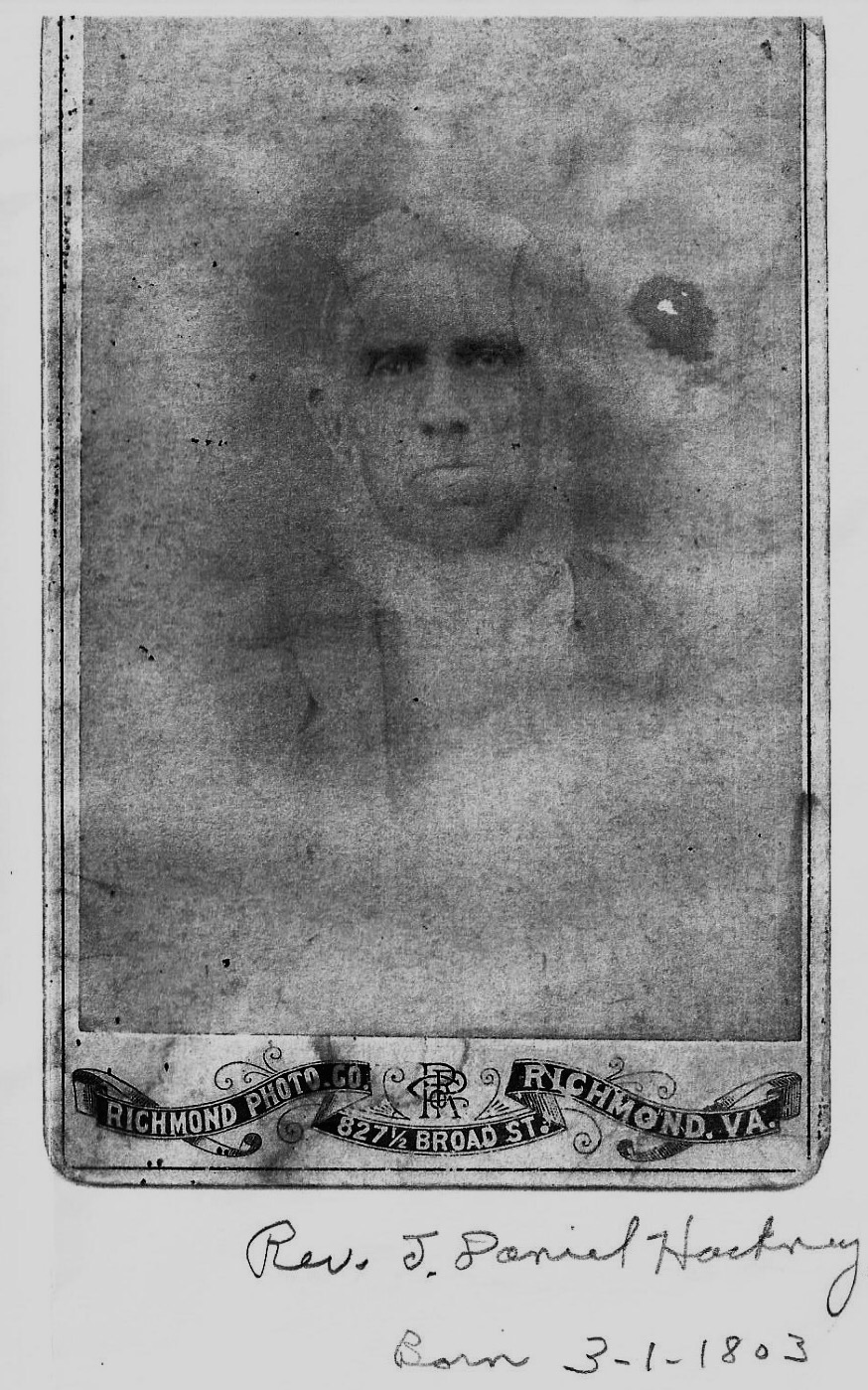
His name was Daniel Hackney, Jr., and he’s my great-great-great-grandfather. He was a politician in the General Assembly of North Carolina in the 1840s and 1850s, a member of the Whig Party who became a Democrat after the demise of the Whigs, a slaveholding Baptist deacon who became a post-slaveholding preaching elder in Baptist churches, and a Unionist (an as-it-was-with-slavery Unionist rather than an as-it-might-be-without-slavery Unionist) during the years before secession who would then be elected 3rd lieutenant in the Confederate Home Company for Chatham County, North Carolina, during the Civil War.

The Chatham County slave schedules from the 1860 United States Federal Census don’t include the names of those Hackney enslaved. They are simply counted as property under his name. 14 in total, most of them children, including a one-month-old baby. 13 were Black; one 60-year-old woman was biracial. There were eight males and six females. None were fugitives or had been manumitted. Together they lived in three slave houses.

When I first saw this, I kept a copy of it on my beside table. I stared at it every night before trying to fall asleep, haunted by the fact that I was directly connected to the institution of slavery in America. There are a lot of individual lives, a lot of real people whose names are forgotten, represented on this list. But if only one were listed there, it would be one too many.

So I’m reflecting on all of this in a series of posts. For now, however, I’ll begin with Hackney’s strong religious identity.

In 1823, at the age of 20, Hackney was baptized as a Christian and became a follower of Jesus Christ. He was one of the first deacons for Love’s Creek Baptist Church, which is located about two miles east of Siler City, North Carolina, when that congregation was organized in 1833. After his service in the Home Guard and after those he formerly enslaved were no longer his “property,” Hackney was finally granted a license to preach in 1866 and ordained as a preaching elder in 1871 in the Sandy Creek Baptist Association.

Interestingly, in 1835, that association had opposed not the institution of slavery entirely but, specifically, “buy[ing] and sell[ing] Negros, for the purpose of speculation or merchandise, for gain” as “inconsistent with the spirit of the Gospel of Christ” and advised churches “to exclude members who will not abandon the practice.” Later, in 1847, the association was asked this question: “Is it agreeable to the gospel for members of the Baptist Church of Christ to buy and sell human beings, or keep them in bondage for life?” The only answer referred back to the minutes of the association for 1835, which ignores the part about lifelong bondage.

So it is not surprising that Hackney frequently represented his church at meetings of the Sandy Creek Baptist Association during the more than three decades between the time those first statements were affirmed 1835 and his receiving a license to preach. Clearly, enslaving human beings and treating them as property wasn’t, in itself, a reason to be excluded from meetings.

When he died in 1884, Hackney’s will included a charitable bequest in the amount of $100 to the Baptist Foreign Missions in China. A newspaper announcement of that bequest noted that it was in fulfillment of a promise he had made 35 years earlier, which would have been in the middle of his political career and long before those he enslaved were set free. His obituary declared that from his baptism until his death, Hackney “made his secular interests subservient to his religious duties.” It pointed out that he had been a successful businessman earlier in his life and “accumulated a handsome estate, which he used liberally in promoting the cause of Christ.”

Like most of us to one degree or another, Hackney seems to have been a tangled knot of contradictions. For him, Asians were worthy of conversion to Christianity while Africans were bought and sold as part of chattel slavery. The latter was not seen as something contrary to his “religious duties” and provided the source of his wealth. That wealth was then used “to tell the old, old story of Jesus and his love,” quoting a hymn verse that was written the same year Hackney started preaching.

One of the things I love about America is the fact that our ideals about universal human rights can be the source of a reformation from time to time. The Thirteenth Amendment to the United States Constitution, which abolished slavery in the 19th century; civil rights legislation that ended racial segregation in public places in the 20th century; and our discussions about racial discrimination, law enforcement, and the dignity of every human being in the 21st century are examples of this.

Blessedly, the same thing happens from time to time within Christianity. Christian faith can become the means by which some of those knots become untangled. As the late Black preacher Peter Gomes, formerly of Harvard University’s Memorial Church, noted a decade ago at Trinity Episcopal Church in New York City:

[I]t is instructive to examine how the religion of white slave owners became an instrument of liberation for slaves, rather than the instrument of docility the slave owners had hoped.

“The Christian faith was stronger than the Christians who used it,” he said, because white Christians could not corrupt Jesus’ truth.

I find that to be a hopeful testimony of faith not only for myself but also for this slaveholding ancestor of mine. Hackney, too, in words from the Book of Common Prayer, which are addressed to our Lord and Savior Jesus Christ, is “a sheep of thine own fold, a lamb of thine own flock, a sinner of thine own redeeming.” He rests in those everlasting arms — but not because some thought he was “a man of intellect and great force of character,” as the Wilmington Morning Star newspaper said of him after his death.

No, he rests there only as a recipient of unmerited mercy.

This I believe.

Click here to read all of the reflections in this series.

Unity in Mission Papers and Sermon

9781514741436_p0_v1_s192x300As noted in my introduction to “The Rector’s Report and Unity in Mission,” the Rt. Rev. C. Andrew Doyle, Bishop of the Episcopal Diocese of Texas, recently granted his permission for same-gender marriages to be conducted at Palmer Memorial Episcopal Church in Houston, in accord with his revised Unity in Mission Policy and the paper Unity in Mission: A  Bond of Peace for the Sake of Love. The letters and documents that were sent to him to make that determination have been made available to the congregation and are also linked in the list below:

The Rector’s Letter to the Bishop

The Senior Warden’s Letter to the Bishop

Unity in Mission Task Force Report and Recommendation

Understanding Diverse Perspectives on Same-Gender Marriage

Why People Are Opposed to Gay Marriage

Conversation Guidelines

Brief Summary of Positions on Same-Gender Marriage

Unity in Mission Summary

In the fall of 2013, my previous congregation in a first-ring suburb of Minneapolis was in the midst of a similar conversation. Same-gender marriage had become legal earlier that year in Minnesota, and a pastoral letter from the Rt. Rev. Brian N. Prior, Bishop of the Episcopal Diocese of Minnesota, which included guidelines for his clergy, was written in response to that change in civil law. Most of my parishioners embraced that out of love for our gay and lesbian brothers and sisters in Christ.

Two things that had shaped my own thinking about same-gender marriage by this time were the Rev. Gray Temple’s short and accessible book Gay Unions in the Light of Scripture, Tradition, and Reason and a public discussion in 2012 that I attended at the University of Minnesota between David Blankenhorn and Jonathan Rauch, moderated by On Being’s Krista Tippett, about “The Future of Marriage.” I commend both resources to everyone who desires to strengthen the institution of marriage.

While my congregation reflected on this, I responded to a request for pastoral care from two men in my community of faith who had been in a committed and loving relationship for more than three decades. These faithful Christians hoped to be married on the thirty-third anniversary of their first meeting. So, following the guidelines of the Bishop of Minnesota, I agreed to officiate at their marriage on that anniversary. It took place at a neighboring Episcopal parish since my own parish was honoring and completing the process outlined by our bishop in his letter.

I thought about that a lot the next year, after we had moved to Texas. My wife Carrie and I celebrated our eleventh wedding anniversary on October 11, 2014. The next morning, on Sunday, October 12, the flowers at Palmer Memorial Episcopal Church were given to the glory of God in thanksgiving for the first wedding anniversary of a same-gender couple in my new congregation. Monday, October 13, marked the first wedding anniversary of the two men in Minnesota whose marriage I had blessed.

Acknowledging the fact that there are people whom I know and love deeply who will disagree with me about all of this, I think it’s important for me to share with others the words of my sermon at that wedding more than three years ago in Minnesota. The happy couple have given me permission to do so, for which I am most grateful.

Here’s what I said:
Continue reading

The Rector’s Report and Unity in Mission

Last Sunday was a very important moment in the life of Palmer Memorial Episcopal Church in Houston, Texas. It was the day of our Annual Parish Meeting, which is a time to worship together and reflect on our place in this world as followers of Jesus Christ. As I have stated elsewhere under extremely different circumstances:

Love . . . became the thread that made a connection between all of us. It brought to mind the opening words of a beautiful antiphon that I didn’t quote in my remarks but have contemplated a lot: “Ubi caritas et amor, Deus ibi est,” which means, “Where charity and love are, God is there.”

This I believe. With that in mind, here are the words that I spoke from the pulpit, with information about the celebration and blessing of same-gender marriages, which the Rt. Rev. C. Andrew Doyle, Bishop of the Episcopal Diocese of Texas, has since granted his permission to conduct at Palmer Memorial Episcopal Church:

THE RECTOR’S REPORT

DELIVERED AS THE SERMON ON JANUARY 17, 2016

Today’s sermon is actually my report as the Rector of Palmer Memorial on the day of our Annual Parish Meeting. There comes a time when the new Rector becomes simply the Rector. I think it’s safe to say that at some point over this past year, we crossed that invisible line. To quote the words of Peter to Jesus from the Gospel of Matthew in the stained glass window above Palmer’s altar:

Lord, it is good for us to be here.[1]

Of course, his words were spoken on the Mount of Transfiguration, and those who remember that story will surely remember that Peter and the others didn’t stay there on the mountaintop but went down into the valley and set their faces toward Jerusalem. They have an indescribable experience in the presence of Jesus, a glimpse of divine glory, then walk with Jesus through the world, not as they wish it to be but as it really is. That’s exactly what happens here at Palmer.

In a variety of ways, people encounter beauty in this church — in the building itself, in the art that surrounds us here, in liturgy and music, in friendships with deep roots, in the simple act of receiving together bread and wine made holy food by the promise of Jesus and the power of the Holy Spirit. It’s not a beauty, however, that comes from the perfection either of who we are or of what we bring to offer. To believe that to be true would be a form of idolatry. Whenever perfection becomes an end in itself, especially in the name of God, people are inevitably hurt because human beings, as it turns out, are imperfect 100% of the time.

HFSSAs Lutheran pastor and writer Nadia Bolz-Weber would say about her admittedly quirky congregation in Denver — The House for All Sinners and Saints — community is more important than perfection. Such beauty found together inside these walls, surrounded by crying babies and restless children and doubters and seekers and the unloved and the unloveable and those of us who are simply a mess, is a reflection of the God in whom we believe. We’re able to love one another because God loved us while we were still sinners. Without that love, all the rest of the things we do here are meaningless, “a noisy gong or a clanging cymbal” as Paul would write in his letter to Christians in the City of Corinth.[2]

Just a few minutes ago, we heard other words read to us from Paul in that same letter. Describing a kaleidoscope of spiritual gifts, he assures those disagreeable Corinthians that “it is the same God who activates all of them in everyone. To each is given the manifestation of the Spirit for the common good.”[3] I like what the late Baptist preacher Fred Craddock said about these gifts, which none of us created or possess alone. In a sermon about this passage from First Corinthians, he wrote:

Some years ago someone broke into the church, pried open the door to the room where the vocabulary is kept, and stole one of the richest words the Christian community possessed. The word was charisma. It was peddled on the street and soon came to be used by everybody for everything: an exciting personality, a particular hairstyle, photogenic face, stimulating speech, provocative style of leadership. The word is a form of charis, grace, from which we get eucharist, and is the background word for charity. Charisma is a gift, and it is Paul’s insistence that when we talk of these matters, we call them what they are — gifts of God. Apart from that association with God and grace, we might as well be discussing magic and horoscopes.

And the word for Paul is plural, charismata; there are varieties of gifts. By its repetition it can be assumed that diversity of gifts is Paul’s insistence.[4]

In other words, we need one another, not in spite of but because of all of our God-given differences. Only together are we a community that can be called the Body of Christ. That image of the human body, with its many and varied parts, is the metaphor Paul will use next in his letter, reminding the Corinthians and us that “we were all baptized into one body” and that “the eye cannot say to the hand, ‘I have no need of you,” nor again the head to the feet, ‘I have no need of you.’”[5] That’s easier said than done, of course, in the cultural landscape that surrounds us. But we belong to another kingdom, a heavenly country where God’s love reigns eternally.

Palmer is where we learn the grammar of that love, practicing it imperfectly and making mistakes, receiving not only forgiveness but also renewed strength for the journey. Over the past year, others have joined us on this pilgrimage. Indeed, the very word Palmer has referred historically to someone who had returned from the Holy Land with a palm frond or leaf as a sign of having undertaken a pilgrimage. Two of those new Palmers who are walking beside us are new faces on our church staff — the Rev. Alex Easley, our Curate, and Roger Hutchison, our Director of Christian Formation and Parish Life.

Alex EasleyAlex was appointed by Bishop Andy Doyle of the Episcopal Diocese of Texas to serve our congregation as a curate for a period of two years. Last summer she was ordained as a transitional deacon at Christ Church Cathedral. Since then, many of you have gotten to know Alex through her work here in the areas of pastoral care, outreach, young adults, and youth. God willing, this Wednesday, January 20, Alex will be ordained to the priesthood at Palmer by Bishop Doyle. And you are all invited to that ordination service, which will begin at 6:30 p.m. and be followed by a festive reception.

Roger HutchisonRoger I’ve known for nearly 20 years. He came to Palmer after serving for 17 years on the staff of Trinity Cathedral in Columbia, South Carolina. As most of you know, Roger shapes Christian faith in the lives of young people and adults not only through stories and conversations but also through art. He’s the author of The Painting Table: A Journal of Loss and Joy and of another recently published book called Under the Fig Tree: Visual Prayers and Poems for Lent.

A week from this Wednesday, January 27, Roger and I will begin leading an evening series called Painting the Psalms. We’ll take a look at a selection of psalms, with me focusing on the poetry and theology while Roger leads us in an artistic response to that. More details about all of that will be forthcoming, and I hope you’ll join us.

The Painting Table

This past year a group of Palmers, including me, were invited to a friendship dinner during Ramadan at the Turquoise Center in Houston to learn about the Turkish culture and Muslim faith of their members. We returned the favor, something that, quite frankly, doesn’t often  happen, inviting them to a presentation in our church about our Christian faith. I talked with them about how that faith affects the way we look at the world after we are sent out from here in the name of Christ.

This past year, as they have done so before, a lot of folks from our congregation also supported the work of an organization called Kids4Peace. It brings together Jewish, Christian, and Muslim youth from the Holy Land for a summer camp experience in various locations throughout the United States, including Camp Allen, which is the camp and conference center for the Episcopal Diocese of Texas. Palmer’s own Stuart Kensinger is a member of our Vestry and a major supporter of Kids4Peace. As Stuart will tell you, participating in these kinds of interfaith conversations does not dilute one’s Christian identity but rather deepens it and brings it into focus. You have to bring your whole self to the table and be clear about who you are as a follower of Jesus Christ. And you can do that while building friendships across the boundaries of your own faith as a Christian. I think Palmers can be role models for this.

Kids4Peace

In fact, you can practice this today. Joining us at this service are Jewish, Christian, and Muslim participants in an interfaith program called Building Abrahamic Partnerships. This series of classes, led by Professor Yehezkel Landau of Hartford Seminary, began last Tuesday at the Turquoise Center and concludes this afternoon here at Palmer with a meal together and a final discussion in St. Bede’s Chapel.

As most of you probably know, welcoming refugees and helping them resettle in the City of Houston has long been a part of the work of this congregation. Last spring, Palmer completed the more than one year co-sponsorship of the resettlement of an Eritrean mother and child. Soon we will begin the co-sponsorship of a refugee family from the Congo. You’ll have the opportunity, as always, to share in this important ministry. So look for announcements that invite you to become involved in this holy work in the weeks and months ahead.

That begins today, in fact, for the children and youth who will gather in Holy Cross Chapel during our Annual Parish Meeting. They will be decorating fabric squares that will be made into a quilt and presented as a gift to a refugee family.

Decorated Quilt Squares

Last but not least, most of you will recall that I announced in my report last year that I would appoint members to three task forces to look at three important areas of our life together. The first was a Youth Task Force, led by our Junior Warden, Courtney Daniell-Knapp, which facilitated a diocesan assessment of our youth programs. The members of this task force are continuing to support Roger Hutchison in his first year of ministry at Palmer, and they are also working together with Roger to define the best leadership model for our youth programs going forward.

The second was a Mission-Beyond-Our-Walls or Outreach Task Force, led by Bill Kersten, which has been studying and reflecting on the numerous opportunities that we have as a church to connect with the neighborhoods that surround us. The continuing work of this task force is especially important because of the transition that happened at the end of the summer with the closing of the Way Station, our outreach to the homeless for more than 24 years, which included serving breakfast on this campus to our clients during the workweek. We are now working in partnership with the Star of Hope Mission, which has supported the homeless with transformational programs for more than a century in the City of Houston.

Star of Hope Mission

You can expect to receive a survey from this task force in the near future. You will also be invited to participate in something that I’m very excited about this spring — a day of service when Palmers worship together at a service like this in the Season of Easter before being sent to be the church out in the community. There will be all sorts of opportunities that you can sign up for beforehand from serving meals to the homeless to singing for the residents of nursing homes, making cakes for families in shelters, or perhaps going with a eucharistic visitor to bring communion to someone who can’t be with us here. Folks, of course, will also be able to choose to participate in an activity even if they didn’t sign up beforehand.

I’m really excited to see what might happen that afternoon. All of these kinds of things are about overcoming estrangement and isolation and are, therefore, a reflection of the reconciliation that the gospel brings to a broken world.

9781514741436_p0_v1_s192x300The third group that I appointed was a Unity in Mission Task Force. Unity in Mission: A  Bond of Peace for the Sake of Love is the name of a paper that was written by Bishop Andy Doyle and includes opening remarks by former Secretary of State James Baker III. First published in 2012 to address the pastoral and theological issue of the blessing of same-gender relationships, it was revised in 2015 to address the blessing of same-gender marriages.

Palmer’s Unity in Mission Task Force, led by John Wallace, also included Jeanine Baker, Debbie Brassfield, Hal Gordon, Matt Kent, Allison Marek, Elizabeth Maynard, and Patrick Sermas. These sisters and brothers in Christ were asked to follow the guidelines set forth by Bishop Doyle in his revised Unity in Mission Policy for congregations that are considering the blessing of same-gender marriages.

The Unity in Mission Task Force spent the last six months in discernment together, studying materials with a variety of perspectives on the nature of marriage, receiving feedback from parishioners both as individuals and in small group discussions, creating helpful resources to share with the congregation, and praying with one another. That process convinced the members of the task force of three things that are noted in their report: “Reasonable people can hold differing good-faith views about this issue; this is not an ultimate issue; and no matter where an individual Palmer stands on this issue, we can move forward together in the bonds of grace, love, and mercy.”

That report continues with a unanimous recommendation:

. . . to the Rector and Vestry that Palmer embrace the celebration of same-gender marriages.

Last Thursday, I presented that report and recommendation to the members of the Vestry. What followed was a thoughtful discussion about what this would mean for Palmer, the importance of caring for everyone who sits in these pews, including those who disagree with us, and whether the Vestry should vote to affirm this, even though the guidelines from Bishop Doyle only require that the Vestry intend to support the Rector in the implementation of these liturgies. After that important discussion, Palmer’s Vestry did vote to affirm the task force’s recommendation.

Last Friday, as required in his revised Unity in Mission Policy, Bishop Doyle received separate letters about all of this from me as the Rector and from Tim Driggers as our Senior Warden. He also received copies of the report from the task force and of the resources that were created to supplement it. The decision to move forward with this will not become official until Bishop Doyle has approved it.

Those letters, the report of the task force, and its accompanying resources will be made available electronically on the church website this week and in printed copies both in the church office this week and after worship services next Sunday. When those documents become available to you, I strongly encourage you to read them in their entirety. I’ll later suggest additional materials that may also be helpful to you.

As I stated to you last year, your priests have been called to care for everyone in this community of faith in the name of Christ, including our gay and lesbian brothers and sisters. Pending the Bishop’s approval, that statement of mine can now be further clarified to include responding pastorally within the walls of this church to same-gender couples that desire boundaries of publicly declared faithfulness in marriage. I can assure you that it also embraces those who disagree with this. I want to state that clearly this morning. We will care for everyone in the name of Christ.

It seems obvious to me that our community here at Palmer cares deeply about the institution of marriage, that we genuinely desire to support one another in the commitments that healthy relationships require, and that we are willing to love those who sit beside us in the pews as sisters and brothers in Christ. I was pleased, therefore, by the additional recommendation of the task force “that Palmer create a system for strengthening and supporting marriages.” As the report goes on to state:

Marriage itself, as a secular institution and as a spiritual sacrament, is losing ground. It behooves all of us who believe in the fidelity of relationships — as icons of God’s fidelity in relationship with us and as laboratories for human growth in love — to support each other in that daily walk.

To that, I say, “Amen, amen, and amen.”

I believe the spiritual gifts needed to provide that strength and support are already here, not because we are perfect, but because we are present to each other in a community that seeks, in the words of our mission statement, “to know and share the love of Jesus Christ.” It is in Christ that we find our unity, that everyone in our church family is loved, and that our community of faith will truly become, in the words of the Prophet Isaiah, “a house of prayer for all people.”[6]

One of the hallmarks of our congregation has been the ability to disagree openly, lovingly, and vigorously about all sorts of things, while still holding hands, so to speak, around the Lord’s Table. That’s a gift we can share joyfully with the whole world, as we come together to “worship the Lord in the beauty of holiness” today.[7]

AMEN

BACK TO POST Matthew 17:14.

BACK TO POST I Corinthians 13:1.

BACK TO POST I Corinthians 12:6-7.

BACK TO POST Fred B. Craddock, “From Exegesis to Sermon: 1 Corinthians 12:4-6,” Review and Expositor, volume 80, number 3 (Summer 1983) 423.

BACK TO POST I Corinthians 12:13, 21.

BACK TO POST Isaiah 56:7, as phrased in Noah Webster’s 1833 limited revision of the King James Version of the Bible.

BACK TO POST Psalm 29:2 (1979 Book of Common Prayer translation).