In the Middle of the Night, Easter Arrives

Palmer Memorial Episcopal Church, Houston, Texas
The Reverend Neil Alan Willard, M.Div.
Easter Day, April 17, 2022

Jesus, Savior, may I know your love and make it known. Amen.

Have you ever stumbled onto something that was completely unexpected, and only later realized there was more going on than what you could see? Photographers do this when they spot something which makes them stop and ponder what’s right in front of them, perhaps moving a little or a lot to change their perspective, then capturing in one picture an extraordinary moment that didn’t seem to exist in the world a few seconds earlier.

Sometimes you walk into a crowded room and hear on the other side of that threshold one of many conversations already in progress. And then maybe you cringe internally — or externally — once you realize the person whose voice you hear going on and on about this or that isn’t aware of other nearby realities in the same room — a struggling spouse in recovery from alcohol addiction, a mother whose heart is overflowing with joy over her gay son’s upcoming wedding, a friend who’s just lost a job but only told a handful of people about it. If the person holding court knew of these or any number of other realities in that same room, the conversation might be different.

There are a lot of hidden realities this morning in this room. Some of you don’t want to be here, having been dragged along by a significant other or a grandparent. I see you, and also have sympathy for you. (Know that your grandmother loves you very much, and I love you too!) Others sitting in the pews today have hearts weighed down by grief over the death of a loved one, perhaps over the past year, or perhaps from long, long ago. Many are still trying to figure out how the pieces of the puzzle that is the small part of the world in which we live fit together on this side of the pandemic. You might be worried about that but afraid to say anything about it to anyone else.

Imagine yourself as Mary Magdalene, who came to the tomb of Jesus “while it was still dark,” or the unnamed “other disciple” running with Simon Peter to that same tomb on the first Easter morning.[1] As they encountered the room that is the empty tomb, a sense of joy, a sense of wonder, a sense of divine majesty, wasn’t part of the experience. Something was very wrong. That’s why Mary ran back to tell the others that the body of Jesus had been stolen. What she had seen just compounded the trauma that had followed the events of Good Friday and the silence on the sabbath day.

Only when Mary, while overwhelmed and weeping outside the tomb, heard herself being addressed by name did she recognize Jesus standing in front of her. She had mistaken him for the gardener. Yet it was Jesus, who had died, and who now was alive — alive but also somehow very different, and known but only because he had made himself known.

“I have seen the Lord,” she would later say.[2]

For Mary, being called by her name changed everything in an instant — the identity of the person in front of her, whom she had already seen with her own eyes, the meaning of the empty tomb, and the movie playing over and over in her head about what had happened in the middle of the night.

Something terrifying had indeed happened, but not in the way Mary had first imagined. It was instead terrifying in the sense that the voice of the Lord shatters the cedars of Lebanon, and in the darkness that same voice brought Jesus, the Christ, the Messiah, over from death to life, setting free all those imprisoned by sin and death, and giving to us a glimpse of our own resurrection in the world to come — in the world beyond our fears and our failures — a new creation that transforms tears of sorrow into tears of joy and, yes, tears of laughter.[3] How could there not be laughter with God?

Is it possible — just possible — that even this very small part of the world in which we live is much larger than we have imagined it to be? Is it possible there’s a lot more going on around us and within us than we can see?

Right outside the front doors of Palmer, on the other side of Main Street, is the campus of Rice University. (The church building in which you’re sitting, by the way, was built in 1927 to be a chapel for the Rice Institute before becoming the home of an Episcopal congregation in 1929.) This whole area is one of the most beautiful parts of the City of Houston — the live oaks, the azaleas, and the wildlife — squirrels, of course, and rabbits, an occasional possum, and lots of birds — grackles, mockingbirds, bluejays, and owls, which seems appropriate for Rice. (I’m even wearing owl cufflinks today!)

But even if you take time for a walk around the Rice campus, even if you pause to notice, with a sense of awe and wonder, all the other forms of life that surround you, including, of course, the students too — even then you’re only seeing a small fraction of what’s really happening there.

Houston is on what’s called the Central Flyway, and the Rice campus is essentially like a Buc-ee’s for many birds on their way to and from the tropics. But mostly they’re flying overhead, while you’re either sleeping soundly in your own bed or wide-awake and worried, staring up at the ceiling. And we know a lot about them thanks to a man named Cin-Ty Lee. He’s a professor of geology at Rice University, but he’s passionate about birds and has been observing them on Rice’s campus for 20 years.

At the beginning of the pandemic, Cin-Ty and a few others thought that might be a good time to try to record the sound of birds at night.[4] Ambient noise, because of reduced traffic, had gone down significantly. So they set up a microphone, initially in a lemon tree but now on a 20-foot pole, and waited to find out what exactly was going on during the night.

Well, that turned out to be a big ol’ disappointment.

In the beginning, in March of 2020, they heard nothing. And they actually thought they were doing something wrong. It was like their own experience of Holy Saturday, waiting and wondering what had happened. But then everything exploded in late April, when there were suddenly thousands — thousands — of birds passing overhead each night.

They weren’t even hearing all of the birds because some fly too high to be heard and others don’t call out to each other while they’re flying. But they heard thousands of them nevertheless. And those recordings added about 30 new species to the list of birds already known to be present at different times of the year on the Rice campus. That total is now at least 262 species.

Have you seen them all? Do they exist even if you haven’t seen them?

To be clear, I don’t think the meaning of the empty tomb should be reduced to springtime observations in the Northern Hemisphere. But nature does give us hints that there is more to this world than meets the eye. There is so much that we don’t see at all, that we see only partly, or that we see dimly, whether off in the furthest reaches of the universe or — perhaps even more amazingly — right here, right across the street, in this small part of the world in which we live and work, in which we love and grieve those we’ve lost, in which we learn and become curious about the things God has made.

What I want to suggest to you is that you’re only experiencing a small fraction of what’s really happening in the world around you. There are mysteries here that are visible but unseen, and there are mysteries here that are invisible too. What happened last night, so to speak, what happened in the darkness before the first Easter morning, was a mystery.

But Mary Magdalene and the rest of those closest to Jesus believed they had seen him raised from the dead. Perhaps the most mysterious thing of all was that the risen Christ, the one who called Mary by name and revealed himself to her, showed them, and shows us too, that God is for us, not against us.

And just as the risen Christ saw Mary weeping and had compassion on her, “God shall [one day] wipe away all tears from [our] eyes; and there shall be no more death, neither sorrow, nor crying, neither shall there be any more pain: for the former things are passed away.”[5] They are passed away because of what happened in the middle of the night. And one day, having fallen asleep in Jesus, we shall awake in the light of his resurrection.

My friends, there’s more going on in this world, more going on in this very room, more going on in your own life, right now, than what you can see.

ALLELUIA! ALLELUIA! ALLELUIA!

BACK TO POST John 20:1-10.

BACK TO POST John 20:18.

BACK TO POST Psalm 29:5.

4 BACK TO POST Cin-Ty Lee in an interview on the podcast City Cast Houston, “Recording the Night Skies of Houston,” April 11,2022.

BACK TO POST Revelation 21:4. I quoted this familiar verse from the Book of Revelation using the King James Version, which can be heard in composer Eleanor Daley’s powerful anthem “And God shall wipe away all tears.”

Casting Lots to Discern God’s Will

Palmer Memorial Episcopal Church, Houston, Texas
The Reverend Neil Alan Willard, M.Div.
The Seventh Sunday of Easter, May 16, 2021

Jesus, Savior, may I know your love and make it known. Amen.

About six miles from the house where I grew up in North Carolina is a Moravian church called Friedland, which means “Land of Peace” in German. When a man named Tycho Nissen was sent there in 1775 from the nearby town of Salem (now Winston-Salem) to organize that country church, he had been married for less than a month. Although this will sound odd, 12 days before the wedding, he and future wife weren’t even a couple.

Tycho knew he was meant to marry a woman named Salome the same way everyone knew these things in Moravian religious communities in the 18th century — by the use of the lot. Church leaders used three pieces of paper. One indicated “yes” (Ja), another indicated “no” (Nein), and the third was blank, meaning “not yet.” Following prayer, one of those pieces of paper was picked out of a container. [picks a folded piece of paper out of a glass jar and reads it] Hmm, that’s interesting. Maybe I should try that again.

Because Tycho had been appointed to an official task on behalf of the church, organizing that rural congregation, which is why he was required to get married, how they used the lot was recorded in the church minutes.[1]

Church leaders had a discussion about Tycho’s marriage, first suggesting the name of a widow in the community. The lot said no. Then they suggested the name of another woman, and the lot again said no. Finally, they suggested the name of Salome, the daughter of a Moravian minister, and the lot said yes. Seven days later it was announced that Tycho and Salome would indeed be getting married. Five days after that they were.

Now, so everyone here won’t be kept in suspense and worry unnecessarily, just know things worked out for them. They would have four children, including a son named Christian, who is my 4th great-grandfather.

Everyone involved in what I’ve just described truly believed they were doing God’s will, following the biblical example of the early church. Moravians used the lot to make other important decisions too, like where exactly to lay out the town of Salem in 1765. But several years after that, they also used prayer and the lot to decide if it was acceptable in the eyes of God to purchase an enslaved teenager.[2] The lot said yes. Was that God’s will too?

How do you know what God’s will is for you? While growing up, or even as an adult, did you ever throw open a Bible and let the pages settle in the genuine hope that God would somehow speak to you, show you the way, lead you beyond whatever that thing was you were struggling with? Did you ever do it again and again to get a different answer — an answer that was more clear, more like what you wanted to hear? I’ll admit I did that.

Or did you retreat into an intense season of prayer, desperately bargaining alone with the Almighty? (If you give me what I want, if you tell me it’s ok to walk down this path, I’ll do anything for you, O Lord.) In those kinds of conversations, we tend to take up all of the oxygen in the room. And in the silence that follows, too often we jump to the conclusion that God’s will and our will are perfectly aligned. Throughout the years, I’ve witnessed people pray hard, really hard, about difficult things, drawing conclusions about God’s will for them that affect their families without having talked to their spouses or that affect their church membership without having talked to their priests. If you already think God’s on your side, no one will be able to say anything otherwise without seeming to be opposed to God.

There are times when a lot of heartache could’ve been prevented if others, including God, had been invited into those prayerful wrestlings. It doesn’t mean the answer would have been different, but it invites to the table God and those who care about you, who want the best for you, who love you.

In today’s reading from the Acts of the Apostles, we heard about prayer in combination with the casting of lots to figure out what to do next. Drawing the short straw, picking a name out of a hat, throwing dice — whatever you want to call it — goes back thousands of years to the first books of the Bible. It’s how Moses distributed land to the tribes of Israel.[3] It’s how his brother Aaron picked the right goat to make a sacrifice to God.[4]

Aaron and the other high priests of Israel who would follow after him wore something called the “breastplate of judgement,” which held a couple of mysterious objects called the Urim and Thummim. Those words in Hebrew appear on the logo of Yale University, where they’re also translated somewhat expansively as “Light and Truth.”[5] Surely we’d like to have light and truth shining upon us while facing a difficult decision.

The Urim and Thummim were taken out of that breastplate when the priests needed to know the will of God. They were probably thrown like dice in a ritual to do that.[6] [throws dice on the floor and looks down at them] I have no idea what that means. I must have skipped that class in divinity school.

Anyway, after the death of Judas, the eleven remaining apostles cast lots after they reconvene in the upper room to discern the will of God and figure out the restoration of the twelve — meaning twelve apostles, those who are sent, representing the twelve tribes of Israel. It was an unusual election with two fully qualified candidates, but with only one presumably divine vote.

That’s how Matthias is chosen to be an apostle, someone who had been with Jesus from the beginning, from the moment of his baptism by John the Baptist. And he believed he was called to that new role, called by God, to be a witness to the resurrection of our Lord and Savior.

What’s important about the story of the calling of Matthias isn’t the casting of lots. The point isn’t the method but the posture.[7] Together as a community those gathered in that upper room turn toward the lovingkindness of the God who raised Jesus from the dead. Together they search the scriptures. Together they pray. And they finally loosen their grip, letting go, confessing their limitations, allowing God to speak to them.

And that’s the part I left out when describing 18th-century marriages in the Moravian Church. It was really about communal discernment, a form of semi-arranged marriages in which proposed matches were discussed after having been suggested either by the men or by the church leaders. A “yes” from the use of the lot merely gave a green light to proceed with that same process. The women could still say no, which they sometimes did.[8]

That’s a stark contrast to the time Moravians needed to make a decision about owning a human being as property. When that was put to the lot, the community wasn’t working together, they were divided.[9] There’s a sense in which the lot was used to break a tie, but not a tie between two equally noble choices as in today’s story from the Book of Acts.

In this case, I believe their trust was misplaced, focusing on the lot rather than on their relationships, including their relationships with the strangers in their midst — people like that enslaved teenager, who had a different language, a different history, a different color of skin. When the Moravian Church wanted to be released from the economic burden of caring for him, he was granted his freedom. By that time, however, he and his wife were older and would struggle to provide for their children.[10]

Earlier I mentioned my fourth great-grandfather Christian Nissen. His brother-in-law, John Vogler, was a Moravian artisan and silversmith. John sought permission to marry seven times in Salem from 1814 to 1818. Six times the lot did not say yes, and one time the woman said no.[11]

Then, in 1818, the Moravian Church stopped using the lot in this way for marriages, with the exception of proposed marriages for ordained ministers.[12] Only then did John ask a woman named Christina to marry him. She was who he had first wanted to marry four years earlier. Since he was a silversmith, he made her wedding ring, which had this inscription:

With God and Thee My Joy shall be.[13]

Well, hearing the words of that inscription, it’s clear John believed that God, beyond the use of the lot, would be very much at the heart of their marriage. Perhaps the Holy Spirit had been at work in a strange way throughout those four years — and still is today — showing us, at the end of the day, that love really does win in this or some other important part of our life.

And it’s important to know that there still remained a circle of prayerful discernment about that engagement, beyond John Vogler himself, which included the Christian community to which he and Christina belonged.

The truth is that we see in the Book of Acts many different ways in which the followers of Jesus open their hearts to God’s will for them. The casting of lots to set apart a new apostle in today’s reading erases the humiliation of the casting of lots for the clothing of Jesus by the Roman soldiers who were executing him. In that scene at the cross in the Gospel of Luke, it appeared that God was absent, that God either didn’t care or didn’t exit.

But as we’ll be reminded next Sunday, God did care. God didn’t leave empty either the building or the space between us after Jesus, crucified and risen from the dead, returned from whence he came. On the Day of Pentecost, the Spirit would be poured out upon the followers of Jesus, filling each of their hearts and every corner of the world with the divine presence, with mercy and grace. The glory of God went with the people of God.

And once that happens, we never read again in the New Testament about the use of the lot to discern God’s will. It’s as if a page had been turned and a new chapter had begun. So I invite you to come back here next week to focus on the outpouring of the Spirit more than on the drawing of straws. The Spirit intercedes for us, even when we don’t know how to pray or how to throw dice, even when we’re unsure about what to do next, even when we get it wrong, helping us realize that, turning us around, drawing us back into a community of open hearts and open hands. This I believe.

AMEN

BACK TO POST Records of the Moravians in North Carolina, Volume II, 1752-1775, edited by Adelaide L. Fries (Raleigh: Edwards & Broughton, 1925) 895.

BACK TO POST “The Stories of Bethabara’s Enslaved,” Historic Bethabara Park website.

BACK TO POST Numbers 34:13-15.

BACK TO POST Leviticus 16:5-10.

BACK TO POST Joel Baden, Twitter thread on Exodus 28:13-30, April 5, 2021. He is Professor of Hebrew Bible at Yale Divinity School in New Haven, Connecticut.

BACK TO POST Joel Baden, Twitter thread on Exodus 28:13-30, April 5, 2021. He is Professor of Hebrew Bible at Yale Divinity School in New Haven, Connecticut.

BACK TO POST Jerusha Matsen Neal, “Commentary on Acts 1:15-17, 21-26,” Working Preacher website, May 16, 2021.

BACK TO POST “The Relation of the Lot [to Moravian Marriages],” Bethlehem Digital History Project website.

BACK TO POST “The Stories of Bethabara’s Enslaved,” Historic Bethabara Park website. A newspaper article that explores the complexity of enslavement within the Moravian Church is “Hidden in History: Old Salem’s Hidden Town” by Kathy Norcross Watts, Winston-Salem Journal, February 1, 2018. Another one is “Slavery in Old Salem” by Susan Ladd, Greensboro News & Record, February 3, 1992. A book that explores this in depth is Jon F. Sensbach’s A Separate Canaan: The Making of an Afro-Moravian World in North Carolina, 1763-1840 (Chapel Hill: University of North Carolina Press, 1998). While it’s true the enslaved teenager, whose Christian name would be Johann Samuel, wanted “to know the Saviour” and asked to be purchased by the Moravian Church, he was nevertheless bought as human property “by permission of the Lord.” Additional details can be found in the first link in this footnote from Historic Bethabara Park.

10 BACK TO POST  “The Stories of Bethabara’s Enslaved,” Historic Bethabara Park website.

11 BACK TO POST “Teaspoon,” Museum of Early Southern Decorative Arts website. This article about a silver teaspoon created by John Vogler includes biographical information about him and other historical facts.

12 BACK TO POST “Teaspoon,” Museum of Early Southern Decorative Arts website. This article about a silver teaspoon created by John Vogler includes biographical information about him and other historical facts.

13 BACK TO POST “Teaspoon,” Museum of Early Southern Decorative Arts website. This article about a silver teaspoon created by John Vogler includes biographical information about him and other historical facts.

The Fourth of July & Confederate Statues

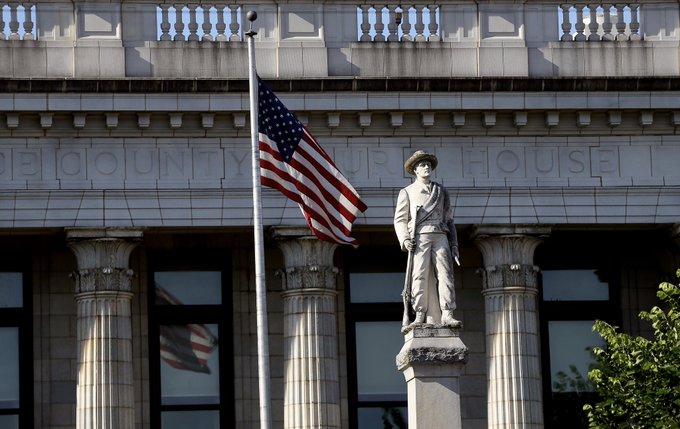
Photo of Alamance County Courthouse in Graham, North Carolina, by Bob Karp

It’s not uncommon to hear people whose skin color looks similar to mine say that if your family history was deeply rooted for many generations in a small Southern town, you’d understand what the Confederate monument in front of the courthouse for that county represents. Two of my grandparents are buried in Alamance County, North Carolina, as many other relatives have been through the years. I even have a fourth-generation slaveholding cousin who was named in the 1914 dedicatory speech for the Confederate statue that stands in front of the Alamance County Courthouse in the center of the Town of Graham. He led a company of Confederate soldiers from that county, where he is also buried. So I know what it represents.

Black Americans whose ancestors were only emancipated from slavery after the defeat of the Confederacy know too. And that is why I believe, as an American and as a Christian, there’s a moral imperative to move it.

The atmosphere in which that dedication took place is well illustrated by the front page of the Greensboro Patriot newspaper from May 11, 1914. One article describes a district meeting of the United Daughters of the Confederacy that had recently been held in Guilford County. The chapter from Graham reported that a monument to the Confederate soldiers of Alamance County had been completed and would be unveiled the following weekend. The article trumpets these words like a fanfare:

Nearly every month sees a new Confederate monument erected. A most important undertaking of the various chapters relates to the preservation of the true history of the Confederacy. This feature is to be stressed even more in the future than it has been in the past . . .[1]

The column beside those words has a report about a proposed movie theater that an association of Black churches wanted to establish on property owned by a well-known Black citizen in the City of Greensboro. According to that newspaper article, “a storm of protest arose from the white residents of the community.” They signed a petition opposing the proposal, showed up at a public forum with their “fighting clothes on, figuratively speaking,” and were represented by two attorneys. For example, the article describes at length one public comment, stating that:

. . . one of the good ladies who addressed the commissioners asserted that the common run of negroes care nothing for a moving picture show, anyway, and asked why should they go to see pictures of people cutting and shooting folks when they could engage in this pastime in reality.[2]

That is a very embarrassing but real testimony from the racist world in which the Confederate monument in neighboring Alamance County would be celebrated by a cheering crowd of white citizens five days after those words were printed on the front page of a newspaper. The guest speaker on that occasion was Henry A. London from nearby Pittsboro. A week after the Wilmington “Race Riot” of 1898, in which an armed white mob took control of the City of Wilmington and expelled Black elected leaders, London published these words in the Chatham Record:

Wilmington is once more ruled by respectable white men and all her citizens are now safe and secure in their lives, liberty and property.[3]

In his speech sixteen years later in front of the county courthouse in Graham, London went out of his way to note that the soldiers of the Union army included “186,097 negroes” and that some of the Confederate veterans listening to him in the audience who had been prisoners of war:

. . . may, (I am telling the truth about it), have been guarded by negro soldiers who would shoot your comrades down without any excuse.[4]

In contrast to that, London was standing there in Graham, as the local Ku Klux Klan founder and leader who introduced him put it, to praise “the achievements of . . . our own race and blood,” something “in which we all have a common interest.”[5]

That was a rallying cry for white supremacy.

There’s an irony which should not be overlooked in London’s soaring rhetoric following the introduction of him as he described the “brave and gallant men” who marched off to war in rebellion and “the dangers and the hardships” they endured, which “the young people of to-day . . . cannot imagine.” It turns out that London wasn’t engaging in false modesty entirely when he said at the beginning:

I do not deserve to have been selected to address you on this occasion.[6]

Although described in the newspaper as a major, that rank had been bestowed upon him not by an army but by a veterans’ organization. London had been a private, serving only for the last several months of the war after he was forced to do so. Before that he had been a college student at the University of North Carolina and made this honest confession in a letter which he wrote to his sister in early 1864:

I would not care much if they did [conscript me], as I hate the idea of skulking, as it were, out of the army, when my Country needs my services so much, but yet when an exemption is proffered a man, he can scarcely be blamed for taking it.[7]

This crowd saw an exaggerated man, who sounded like a preacher as he thundered:

. . . and oh! what soldiers they were; men of Alamance, women of Alamance, children of Alamance, remember through all your lives to honor the living Confederate soldiers as well as the memory of the dead ones. Oh! it is a beautiful thing, eminently fit and proper to erect a monument in front of every court house throughout our Southland in memory of the Confederate soldiers.[8]

Those statues would be painful reminders to Black Americans passing by that they would not be treated equally under the law inside those buildings, which were supposed to be symbols of justice for the entire community.

Seventy years before those front-page articles were printed in the Greensboro Patriot, that same newspaper published the names of Whig candidates standing for election in various counties throughout North Carolina.[9] One of them was my great-great-great-grandfather Daniel Hackney, Jr., who was a candidate in 1844 to represent Chatham County, where London lived, in the North Carolina House of Commons. Hackney was a slaveholder in Chatham County, as was his father and grandfather. To the immediate right of his name in that list was this public notice:

To those who are citizens of Alamance County or places like it, please think about what you want your courthouse to say about your community. What, for example, will future generations read in archived news reports that are recording how we think about these things today? Is it a “self-evident” truth for you on this national holiday “that all [human beings] are created equal,” including Black lives?[10]

If you proudly display an American flag, Old Glory, outside your home on Independence Day, what does that symbol mean to you as you consider the wellbeing of your neighbors, including the American descendants of those whose Black bodies were once sold on courthouse steps? Many of their families, like my own, are “from here,” wherever that might be throughout the South. And they have just as much right to be included in “our” history as people who look like me. Of that I am certain. So take down these statues, and if you decide to move them somewhere else, tell the whole story.

BACK TO POST “Daughters of Confederacy: District Meeting Held in This City Showed Good Work Accomplished,” The Greensboro Patriot, May 14, 1914.

BACK TO POST “Negro Moving Picture Show: White Folks Wouldn’t Stand for Its Location in Their Vicinity,” The Greensboro Patriot, May 14, 1914.

BACK TO POST Henry A. London, editorial, The Chatham Record, November 17, 1898.

BACK TO POST Henry A. London, quoted in “Maj. London’s Address: Presentation of Confederate Monument to County and Acceptance,” The Alamance Gleaner, May 28, 1914.

BACK TO POST Jacob A. Long, quoted in “Maj. London’s Address: Presentation of Confederate Monument to County and Acceptance,” The Alamance Gleaner, May 28, 1914.

BACK TO POST Henry A. London, quoted in “Maj. London’s Address: Presentation of Confederate Monument to County and Acceptance,” The Alamance Gleaner, May 28, 1914.

BACK TO POST Henry A. London, quoted by Adam H. Domby, The False Cause: Fraud, Fabrication, and White Supremacy in Confederate Memory (Charlottesville: University of Virginia, 2020) 48.

BACK TO POST Henry A. London, quoted in “Maj. London’s Address: Presentation of Confederate Monument to County and Acceptance,” The Alamance Gleaner, May 28, 1914.

BACK TO POST “Whig Candidates,” The Greensboro Patriot, June 15, 1844.

10 BACK TO POST The Declaration of Independence, July 4, 1776. The preamble includes these words that are familiar to many Americans:

We hold these truths to be self-evident, that all men are created equal, that they are endowed by their Creator with certain unalienable Rights, that among these are Life, Liberty and the pursuit of Happiness.

Bright Star and a Family Tree Secret

When my wife and I purchased our tickets for the musical Bright Star, which was written and composed by Steve Martin and Edie Brickell, we were both excited to hear the music but had no idea what the storyline would be. After we settled into our seats at Houston’s Hobby Center for the Performing Arts, I was pleasantly surprised to learn that it’s partly set in the Blue Ridge Mountains of North Carolina during the post-war 1940s with flashbacks to 1923. I grew up in the Old North State within a short drive of those mountains, and we had our honeymoon in Asheville, where the musical also took us after some family drama in the plot that was inspired by a true event. Amazingly, I had seen a shadow of that story in my own family tree.

In the musical, sixteen-year-old Alice Murphy, who sings “If You Knew My Story” as an adult, meets young Jimmy Ray Dobbs in her hometown of Zebulon. The town, by the way, is a real place named for the Confederate Governor of North Carolina, Zebulon B. Vance. Jimmy Ray’s father, Josiah Dobbs, who represents the Old South, is the mayor and a successful businessman. He believes Jimmy Ray needs to marry someone with a higher social status and that college would be a waste of time when he should really be helping with the family business in order to run it one day.

Things get complicated when Alice becomes pregnant. Josiah arranges for that fact to remain a secret, forces Alice to give up her child for adoption, and promises to take his own grandchild to the adoption agency. On the train ride, however, he does something terrible to ensure that all of the problems he envisions for his son will go away forever. But his plan doesn’t work, and the child grows up, loved by others. There’s more to the story in the musical, but this context is sufficient for my story.

As I heard the words “a man’s gotta do what a man’s gotta do” being sung, I wondered if my great-great-great-grandmother Cornelia Dunevant would have heard the voice of “Royal George” Williamson running through her mind. Cornelia was a complete mystery to me as I researched my family history. She never got married, but did give birth to at least three daughters, including my great-great-grandmother Telula Dunevant in 1855. Cornelia would have been about 17 years old at the time. Telula later married William Cook at 19 years of age, and the best clue to the identity of her father appears on her marriage certificate. She listed her mother as Cornelia and her father as Weldon Williamson, who was a wealthy planter’s son.

But that’s not the only clue, which is important to note since Telula’s death certificate lists her father as someone else and her maiden name as “Don’t Know.” Telula had a son and a grandson who both had Weldon as a middle name and who were each listed on the 1930 United States Federal Census as Weldon Cook. In other words, both of them went by the name Weldon.

There are also genetic clues. One of the reasons that I had earlier decided to take the AncestryDNA test through Ancestry.com is because I hoped it might offer a bridge to confirm a few things in my family tree that were probably true but not proven to be true. Over time, as more close family members, together with more people in general, take the same test, my DNA matches are mapped in a way that illustrates how they might be related to me through a common ancestor. Those DNA matches reveal connections to more than one child of Weldon Edwards Williamson other than Telula. They also reveal connections to more than one of Weldon’s siblings, more than one of his mother’s siblings, and at least one of his father’s siblings.

Weldon’s father had quite a nickname, “Royal George,” and enslaved 142 Africans in Caswell County, North Carolina, according to the 1850 United States Federal Census. When Telula was born, Royal George would have been about 67 years old, and his son Weldon would have been about 23 years old. Royal George died about a year later. There’s neither a passing reference to God nor a stated desire for a decent Christian burial in his will. It’s all business, including instructions about what to do if his four children by his second wife object to how he wants to divide their inheritance.

From the bottom of the first page of Royal George Williamson’s will: “If this rule of division is objected to on the part of my children by my second wife then I direct that the value of their property obtained as aforesaid shall be ascertained [and they shall receive an equal share of my estate less that value].”

And there was a lot to divide. The account documents for his estate include more than 30 pages, partly because so many people owed him money. At the time of the next United States Federal Census in 1860, Weldon is listed on the slave schedules as enslaving 27 Africans. Many if not most of them presumably represent part of the “property” that Weldon inherited from his father. Weldon also inherited Royal George’s family home called Melrose.

Weldon had, not surprisingly, put his relationship with Cornelia behind him and married another woman, Nancy Johnston, about a year after the birth of Telula. “A man’s gotta do what man’s gotta do” to succeed, according to the fictional grandfather in Bright Star. “A man must protect his family and preserve his good name,” he sings, though he’s only preserving an illusion.

Yet just as the rain falls on both the just and the unjust, so too does personal tragedy. Nancy died less than a year after she and Weldon were married. After her death, Weldon sold Melrose to one of his brothers. 68 days after the death of his first wife, Weldon married his second wife Mary Bethel. By 1880, he was a widower again and had moved with his children to Danville in Southern Virginia. He married his third wife Elizabeth Hammond in 1881, and by the turn of the century he and his family were living in Asheville. Weldon died there in the beauty of the Blue Ridge Mountains in 1901.

Traditionally, Christians have called the writer of the Book of Ecclesiastes in the Hebrew Bible the Preacher.  At the very end of that book, the Preacher implies that a light will be shined on “every deed . . . including every secret thing.” For the Preacher, that is God’s judgement. Or maybe it’s just the reality that truth dispels the shadows that haunt us through the years and sets us free. Perhaps all of that is the same thing, allowing us to loosen a little our tight grip on the memories of the past that burden our hearts.

I don’t know how that worked itself out in the hearts of Cornelia, Weldon, or Royal George. What I do know is that Telula lived her life, loved by her children, who put these words on the headstone of the grave where she is buried beside her husband:

FAREWELL, DEAR MOTHER AND FATHER SWEET
THY REST. GOD TAKES THE LIVES HE GAVE.

For some Christians, the family that finally embraces them and accepts them is the community of the church that embodies the outstretched arms of Jesus on the cross. I hope Telula and her mother and, yes, even her absent father experienced that, too, on this earth. And I hope Royal George will experience that in the life to come, reconciled with his children, his grandchildren, including Telula, and the men, women, and children he enslaved, whose lives were just as important in the eyes of God as his own.

All of them, and all of us, need to know that love remains, mysteriously, in spite of the wrongs we have done to others and after the wrongs others have done to us. I don’t know how God will do that, weaving a tapestry of justice for all of the victims of human cruelty, while having taken away the sins of the whole world, including our own. But its loveliness, when finally complete, will bring forth tears of joy because God is love. This I believe.

Click here for a series of reflections on a different slaveholding ancestor.

My Slaveholding Ancestor, Part X

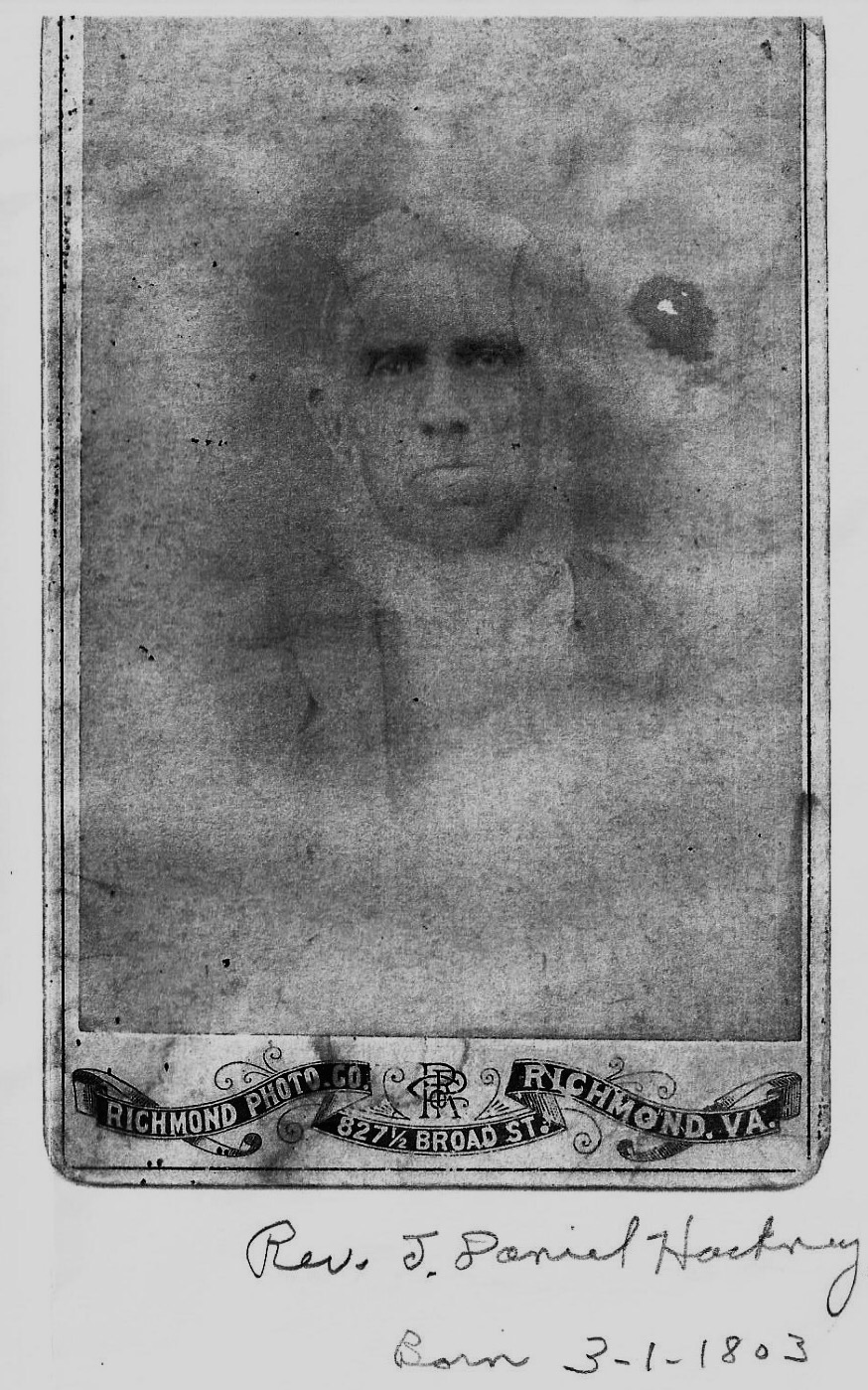
After the end of the Civil War, my great-great-great-grandfather Daniel Hackney, Jr., no longer “owned” 14 human beings as “property.” Their new status as free persons had been guaranteed by President Abraham Lincoln’s Emancipation Proclamation, which was issued on January 1, 1863, freeing slaves within the borders of states in rebellion, and by the 13th Amendment to the United States Constitution, which was ratified by the states on December 6, 1865, abolishing slavery throughout the United States. Hackney, a former politician and former Confederate Home Guard officer and now also a former slaveholder, would spend his post-war years devoted to the work of Baptist churches. He had served as a deacon at Love’s Creek Baptist Church in Chatham County, North Carolina, since 1833. But he was granted a license to preach in the Sandy Creek Association of the Southern Baptist Convention in 1866. Eventually, he was ordained as a preaching elder in that association in 1871, serving as a pastor, without seeming to regret the past or even noticing its dissonance with his Christian faith, until his death on December 28, 1884.

My great-great-grandfather David Williard and his brothers, having been drafted to fight for the Confederacy, returned home to Forsyth County, North Carolina, after the war to resume farming. These men born to Moravian parents didn’t enslave any human beings before secession, so nothing about that reality changed afterwards. However, the economic ruin that had been wrought by the rebellion was obviously different. And so was the psychological trauma of having participated in wartime violence that their Moravian grandparents and great-grandparents would have found abhorrent as members of an originally pacifist Christian community. A line had been crossed. They were now Americans who happened to belong to the Moravian Church (or Primitive Baptist churches), and not Moravians who happened to live in America as in previous generations.

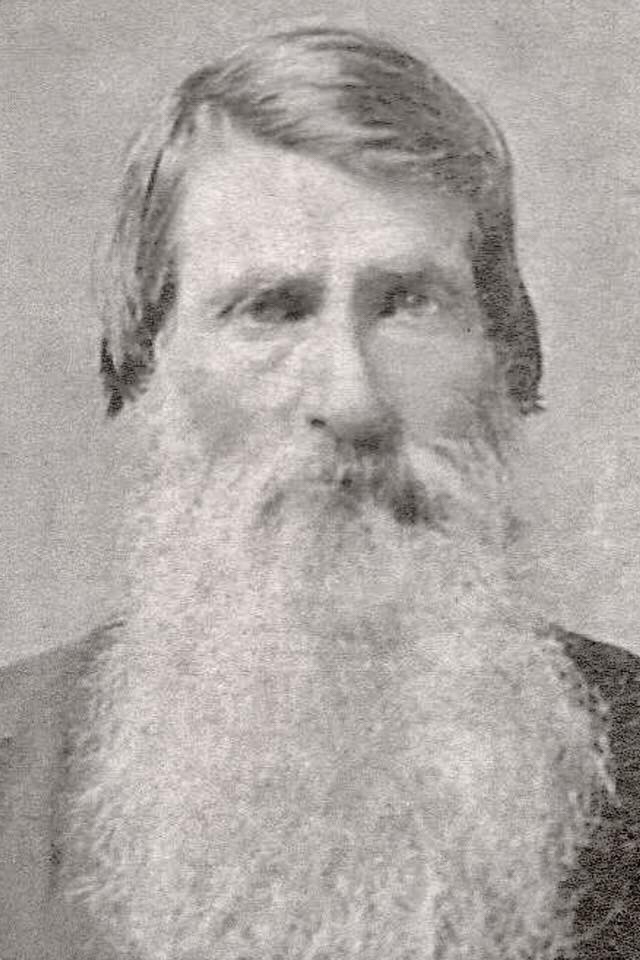
Elkanah, William, Benjamin, and Lee Willard — my second cousins, fourth removed — returned home to Yadkin County, North Carolina, after having remained Unionists throughout the war and having actively opposed the Confederate government in the Old North State. It was suggested that they were members of a secret resistance movement known as the H.O.A. or Heroes of America. There was a warrant for the arrest of William, Benjamin, and Lee Willard and 11 other Unionists for murder “with malice aforethought” after an attempted arrest that led to a shootout with the Confederate state militia. And Elkanah Willard, who can be seen in this photo with the beard of a biblical prophet, was a subject of conversations between North Carolina’s wartime governor and chief justice because of his brash defiance of the authorities. Even though the arrival of the Union army ensured the murder case wouldn’t be pursued, it’s astonishing that these brothers just resumed their old lives.

So my ancestors represented at least three of the groups of people who were living in the “Quaker Belt” of the central piedmont of North Carolina during the Civil War: The wealthy who encouraged young men to volunteer to fight in a war that would mostly benefit slaveholders; yeoman farmers who were drafted into the Confederate army, many of whom deserted or resisted passively; and those who actively rebelled against the rebellion for the sake of the Union. However, when monuments were raised in the 20th century in Chatham and Forsyth Counties to commemorate the historical events of 1861 to 1865, the speeches that accompanied their unveiling glorified ordinary citizens who stepped forward to fight on behalf of the Confederacy with patriotic zeal, ignoring, in a real sense, all three of these groups.

The monuments themselves ignore these same groups and Black Americans who had been enslaved by the rule of law, beginning with the Constitution of the United States, with the imagined blessing of God in the Bible. Those slaves were the human subject of “property rights” that Christian people like Hackney wanted to protect for themselves and their own economic gain by talking about the equal rights of states rather than individuals. However, Black Americans were very much on the minds of the men who gave speeches that praised these monuments before cheering white crowds.

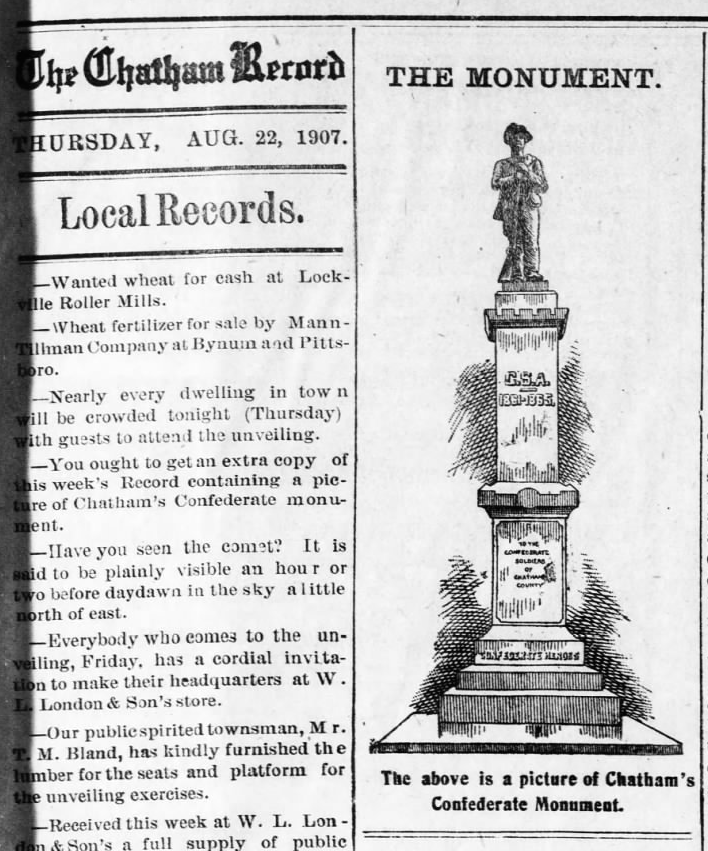
After 20 children unveiled Chatham County’s new Confederate monument before a large crowd in Pittsboro, North Carolina, on August 23, 1907, Chief Justice Walter Clark of the North Carolina Supreme Court was introduced as the guest speaker for the occasion. In his remarks, which the Raleigh Times newspaper published, Clark suggests the possibility that the 14th amendment to the United States Constitution “to secure the rights of the newly emancipated colored people” had not been adopted legally.

Clark would later give the 1920 commencement address at St. Augustine’s School (now St. Augustine’s University) in Raleigh, North Carolina. It’s a historically Black educational institution that was founded in 1867 by the Episcopal Church for the education of freed slaves. Unbelievably, his remarks included these words:

 It is true that our colored people wear “the shadowed livery of the burnished sun” and there is no social equality between the races, but the latter condition exists in every country where there are two or more distinct races of people. The colored people do not wish social equality, and the white people would not tolerate it, and there the matter ends. It is not a matter of debate, but is settled and not a cause of strife like the divergence in language, in religion, in national aspirations which exists in nearly every other country. . . .

There has been some times complaint as to what is known as the “Jim Crow cars,” which are established by law. At the North, where there are few colored people in proportion to the population, the railroads cannot afford to furnish separate cars for them. With us, where nearly one-third of the people are colored, and probably one-fourth of the travelers by rail, it is better for them and the whites that separate cars should be furnished for them. The real objection is that sometimes these cars are inferior to those furnished the whites. This is contrary to the law, which requires the same rate to be charged for fare and the same and equally good accommodations furnished for both races. When this is not done it is not because of the law, but in violation of it, and the remedy is by application to the Corporation Commission to require better accommodations.

As to suffrage, which I do not intend to discuss in any way, I think that the wiser heads among the colored people have discouraged any attempt to intermeddle in politics and that the colored race has lost nothing but gained much by abstaining from doing so against the wishes of the white people, notwithstanding the decision of the United States Supreme Court that the “Grandfather Clause” is void.

Forsyth County’s new Confederate monument had been unveiled in Winston (now Winston-Salem), North Carolina, on October 3, 1905. The guest speaker that day was the Honorable Alfred Moore Waddell, Mayor of Wilmington, North Carolina. And he said, “I thank God that monuments to the Confederate soldier are rapidly multiplying in the land.”

Wadell had been a lieutenant colonel in the Confederate cavalry and was a United States representative during the 1870s. He also participated in a coup d’etat known as the Wilmington Race Riot of 1898, when white Democrats overthrew the legally elected officials of the city and expelled black Republican leaders. Emboldened by Democratic election victories in the fall of 1898 throughout most of North Carolina, an armed white mob seized control of the city. Before sunset, they had forced the mayor, the board of aldermen, and the chief of police to resign.

Waddell, who began his term as the Mayor of Wilmington under these violent and racist circumstances, had made clear his unvarnished white supremacist views in a statement before the election that was published in the Constitution newspaper in Atlanta, Georgia, on November 21, 1898. This was part of the intimidation of Black voters that, together with at least one city precinct in which the ballot boxes were stuffed, contributed to the wide election margins by white Democrats:

So I do not believe those monuments truly reflect or honor the historical events of 1861 to 1865. They certainly are not honest about the white supremacist ideas that undergirded the celebrations after they were erected. Not even General Robert E. Lee thought these “enduring memorials of granite” were a good idea. He wrote a letter in 1869 to decline an invitation to return to Gettysburg, Pennsylvania, with officers who had participated in the battle there for the purpose of marking on the ground where such memorials should be placed. This is how he ended his letter:

I think it wiser, moreover, not to keep open the sores of war but to follow the examples of those nations who endeavored to obliterate the marks of civil strife, to commit to oblivion the feelings engendered. Very respectfully,

Your obedient servant,
R. E. Lee.

W.E.B. Du Bois was a historian, civil rights activist, and the first Black American to earn a Ph.D. from Harvard University. He was one of the founders of the National Association for the Advancement of Colored People, also known as the NAACP, and wrote these words in 1931 in a publication of the NAACP called The Crisis:

The most terrible thing about War, I am convinced, is its monuments, — the awful things we are compelled to build in order to remember the victims. In the South, particularly, human ingenuity has been put to explain on its war monuments, the Confederacy. Of course, the plain truth of the matter would be an inscription something like this: “Sacred to the memory of those who fought to Perpetuate Human Slavery.” But that reads with increasing difficulty as time goes on. It does, however, seem to be overdoing the matter on a North Carolina monument: “Died Fighting for Liberty!”

Last summer I happened to read an op-ed in the Los Angeles Times newspaper that was written by a self-described “black daughter of the Confederacy.” Her name is Lisa Richardson, and, like me, she’s the descendant of a Confederate soldier. The difference, as she notes in her essay, is that she finds herself in that category most likely “through coerced sex and rape,” which was tolerated within the institution of slavery.

Also like me, a victory for one side of her family meant defeat for another side of her family. In Richardson’s case, however, the end of the rebellion brought an end to the institution of slavery and, therefore, freedom to her enslaved ancestors. With her, I rejoice that the rebellion didn’t succeed in its aim to deny that freedom to millions of human beings whose ancestors came from Africa. With her, I lament that white supremacist ideas have survived the fall the Confederacy, emerging renewed as those statues were dedicated and, sadly, continuing into our own day:

History isn’t being erased, but it is being corrected. Relocating a Confederate statue to, say, a museum, is an acknowledgment that we see the naked emperor; we see through the contorted logic that it is possible to separate the Confederacy from . . . slavery . . .

As for my Confederate ancestor, [Jeremiah Dial, who enlisted in the 31st Regiment, Arkansas Infantry,] I consider him without bitterness. He was a man of his time, his family, his community and his culture. He probably wasn’t particularly evil — just an ordinary man, without the advantage we have: [more than a century and a half’s] perspective on the Civil War. I have met a few of his white descendants — my cousins — and we regard each other with genuine affection.

To those who would keep Jeremiah Dial frozen in time, forever trapped at the moment he chose a cause on the wrong side of humanity, I believe you do him a disservice. To those who use him as an excuse to fly the flag of modern-day anti-Semitism, racism and bigotry, you have no right.

To all the bronze Confederate soldiers, in whom I see the image of my great-great-great-grandfather, I would extend this grace. Without resentment or rancor, I would move them into museums and there tell the story of their lives. I would end their utility as flashpoints for racism and division, and, once and for all, allow them to retire from their long service as sentries over a whitewashed history.

I’m grateful that recent scholarship is filling in the gaps in the history that surrounded and shaped the opinions of both my slaveholding and my non-slaveholding ancestors in the 19th century. In 2014, for example, Cambridge University Press published Rebels against the Confederacy: North Carolina’s Unionists by Barton A. Myers, and McFarland & Company published Civil War in North Carolina’s Quaker Belt: The Confederate Campaign Against Peace Agitators, Deserters and Draft Dodgers by William T. Auman.

I’m also grateful that I’ve been able to learn details about connections my great-great-great-grandfather Daniel Hackney, Jr., had to the institution of slavery, both personally and politically, thanks to the resources of Ancestry.com and its affiliates. Even when I disagree with them, it’s amazing to be able to read his thoughts, printed in black and white in local newspapers, about the events of the 1840s, 1850s, and 1860s.

From my point of view, there is nothing to fear about shining a light on the shadows that have been ignored for too long. As for this particular series, there may be future posts about other Unionist cousins of mine whom I discovered through their own testimony and the testimony of their friends and neighbors before the United States Southern Claims Commission several years after the end of the Civil War. Some of that testimony includes references to and claims of secret membership during the war in the Red Strings, a biblically-inspired nickname for the Heroes of America.

I’m also pondering a final post that somehow imagines a conversation, centered on reconciliation, between me and Hackney. However, that will necessitate some time and some prayer to do honestly. So perhaps it will appear in a future season of Easter. That would seem appropriate since I am, like Hackney was, an ordained minister of the gospel of Jesus Christ. The promise of Easter is that God will one day make all things new, including the conflicted and sin-wearied hearts of both Hackney and me with our prejudices, our imperfections, and our many mistakes. As the First Letter of John in the New Testament reminds those of us who are called Christians:

If our hearts condemn us, we know that God is greater than our hearts . . .

To that, I say, “Amen, amen, and amen.” The Lord is merciful to all.

This I believe.

Click here to read all of the reflections in this series.

My Slaveholding Ancestor, Part IX

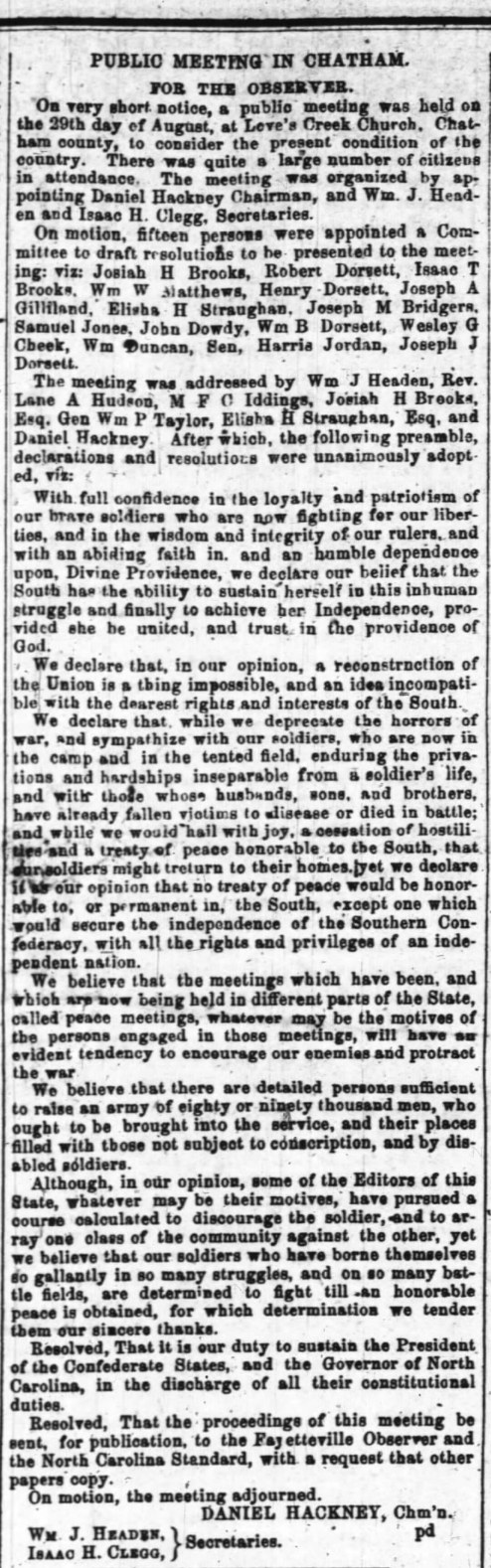
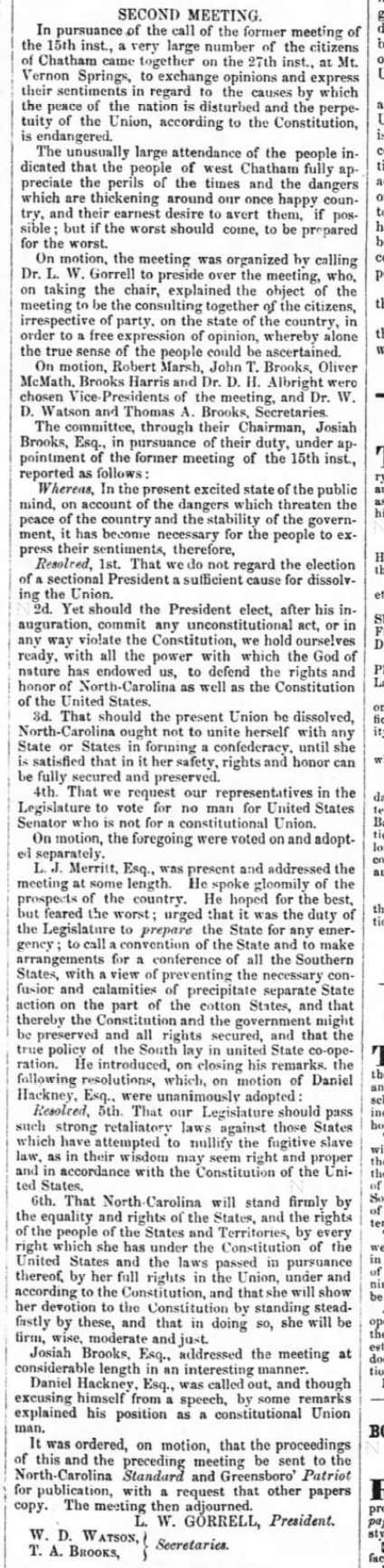
My great-great-great-grandfather Daniel Hackney, Jr., was appointed to chair a public meeting at Love’s Creek Baptist Church in Chatham County, North Carolina, on August 29, 1863. That was nearly two months after the Union victory at the Battle of Gettysburg in Pennsylvania. Hackney, a former politician and an enslaver of 14 human beings, served as a deacon at Love’s Creek Baptist Church, and was 3rd Lieutenant in Chatham County’s Home Guard. His report about that meeting was published in the September 10, 1863, issue of the Fayetteville Observer newspaper in Fayetteville, North Carolina.

After Hackney and other speakers addressed the assembly, those present declared “full confidence” in the Confederate government and “abiding faith” in Divine Providence. They expressed their opinion that “a reconstruction of the Union is a thing impossible” and disapproval of so-called “peace meetings” in various parts of the Old North State. Finally, they resolved that it was their duty “to sustain the President of the Confederate States and the Governor of North Carolina, in the discharge of all their constitutional duties.”

I have other relatives who were just as unwavering in their convictions as Hackney was, only not for his cause.

On November 10, 1862, Henry W. Ayer wrote his official report to Governor Zebulon B. Vance of North Carolina about war-related manufacturing contracts in Forsyth County. His letter ends, however, with a dire warning about Elkanah Willard, whose name comes from the father of the Prophet Samuel in the Bible. This Willard is my second cousin, fourth removed, and lived in Yadkin County, which is adjacent to and west of Forsyth County. Here’s what Ayer said about him, and note that Richard M. Pearson was the Chief Justice of the North Carolina Supreme Court:

I am authorized and requested by Chief Justice Pearson to lay before your Excellency the following facts, There is a man in Yadkin county near Mount Nebo . . . named Elkanah Willard, who openly defied the law, first, By rescueing his brother who is a conscript (he himself is not) from a guard who had him in custody by a display of arms and open force. Secondly, by putting Capt Fleming and the men accompanying him at defiance, in such a way that they were obliged to shoot him down or rush upon him armed as he was at the iminent danger of their lives The Capt says he could have shot him down or at the risk of his life have attempted to arrest him but as he was a man of most desperate character and has 5 older brothers as bad as himself, the better plan he thought was to let him alone — It is the opinion of the well affected neighbors in order to avoid bloodshed that the best policy would be to send an officer with 12 to 15 armed men — to arrest him, supposing that this display of force would let them see their resistance was hopeless and that they would surrender without opposition Whereas it tampered with and not put down at the start it may result in some dreadful evil. The effect of armed men in the neighborhood, would be wholesome in many ways, as there is some disaffection in that part of the County. This man Willard has said he would rather join the Federal Army than ours — The above statement are facts, vouched for by Judge Pearson. Any thing else coming to my knowledge will be promptly reported to your Excellency.

That same year, 1862, Elkanah Willard was indeed arrested for speaking in favor of the Union and rescuing a draft-dodging brother. But that was only the beginning. He was eventually released from custody, legally or illegally, before his next escapades.

15 men gathered in the Bond Schoolhouse, named for a Quaker and near the Deep Creek Friends Meeting House, in Yadkin County on the night of February 11, 1863. That group, which was evading the Confederate draft and making plans to cross over to Union territory in Tennessee, included William, Benjamin, and Lee Willard, who were three of Elkanah Willard’s brothers. Their number increased to 16 early the next day when another member of their party joined them with a newspaper.

Anxious to hear news of the war, they forgot to post a guard. So they were caught by surprise when at least 12 members of the state militia, having been tipped off about their hiding place, rode out to the schoolhouse to arrest them. The shootout that ensued left two men killed on each side, two men wounded among the Unionists, including Benjamin Willard, and no one in custody after the state militia withdrew.

According to one recollection, “the Willard boys did most of the shooting.” The next day, February 13, they were named along with the other 11 surviving Unionists in a warrant for the arrest of all 14 of them for murder “with malice aforethought.” A few days later, four of them — but none of the Willard brothers — were in custody.

That’s the context for attorney R.F. Armfield’s letter to Governor Vance about this incident and how it fit into political debates about the Confederate draft, which was extremely controversial in North Carolina because that draft was not controlled by the state. So states’ rights were, ironically, being trampled upon by the First Congress of the Confederate States of America for the sake of immediate necessity.

After summarizing details of the shootout, Armfield ended his letter to Governor Vance with some cautionary advice. Although the governor was strongly opposed to the Confederate draft on the basis of states’ rights, he zealously rounded up deserters and returned them to their regiments in the Confederate army. That would bring him into conflict with the chief justice of the state supreme court, who did not believe that the governor had authority to do that. So Armfield wrote:

But my principle object in writing this letter is to ask you what we shall do with those four murderers we have and the others if we get them? Suppose we try them for murder, do you not believe our supreme court will decide the conscription act unconstitutional and thus leave these men justified in resisting its execution? I believe they will, and tremble to think of the consequences of such a blow upon the cause of our independence. It would demoralize our army in the field and bring the first horrors of civil war to our own doors and then perhaps subjugation to the enemy, which no honorable man ought to want to survive. . . . I hope you know I am conservative for the rights of the citizens and the States, but for my country always, and for independence at all hazards.

Not surprisingly, therefore, Chief Justice Pearson had the four men who were being held in custody released on a writ of habeas corpus. He believed their detention was illegal. The General Assembly of North Carolina would keep trying to increase the governor’s authority in what would become a continuing legal battle with the state supreme court. So these would not be the last arrests made in this particular case.

More than a year later, in the summer of 1864, three of the 14 surviving Unionists, including William Willard, were captured as they tried to cross the mountains. Those three men were taken to the Yadkinville jail in Yadkin County. But they were rescued in a jail break by a group of armed men, led by Elkanah Willard. The editorial from the Weekly Confederate newspaper in Raleigh, North Carolina, that concluded my last post in this series began with a description of that jail break and claimed that my Willard cousins and others in league with them belonged to an organized resistance movement known as the H.O.A. or Heroes of America.

The New York Times multi-year series Disunion included a post on the shootout at the Bond Schoolhouse called “Blood in the Carolina Hills.” That post contains this interesting sentence: “It proved harder to keep the Willards jailed than to keep a beagle in a pen.” It also offered a description of the work of the Heroes of America:

The [H.O.A.] undermined the Confederacy primarily by encouraging and aiding draft resisters and deserters. An “underground railroad,” operated in cooperation with abolitionists, led deserters and conscripts to safety in Tennessee and Kentucky, where many enlisted with the Union. The organization’s badge, a red string attached to a coat lapel or a home’s threshold or window, gave the Heroes the nickname the Red Strings. The device was adopted from the biblical Book of Joshua, in which a woman in Jericho concealed from capture two Israelites on a reconnaissance mission, then helped them escape by lowering them down the city wall on a red rope. They promised that on their return as conquerors, she and her family would be protected by a “scarlet thread” she was to fasten to her window.

After the Yadkinville jail break, Elkanah, William, Benjamin, and Lee Willard joined a large party of men with arms and ammunition stolen from the Home Guard and, on July 10, 1864, headed toward Tennessee to try to reach the Federal lines there. This group divided into two companies, each one led by an individual “who had from time to time been successful in piloting many conscripts across the line.” While one of the companies arrived safely on the other side, the other one, which included my Willard cousins, was surprised and attacked by the North Carolina militia.

Although many of the men in that company were killed, the Willard brothers were captured and taken to Camp Vance, which was six miles outside of Morganton, North Carolina. They escaped from Camp Vance but were captured again.

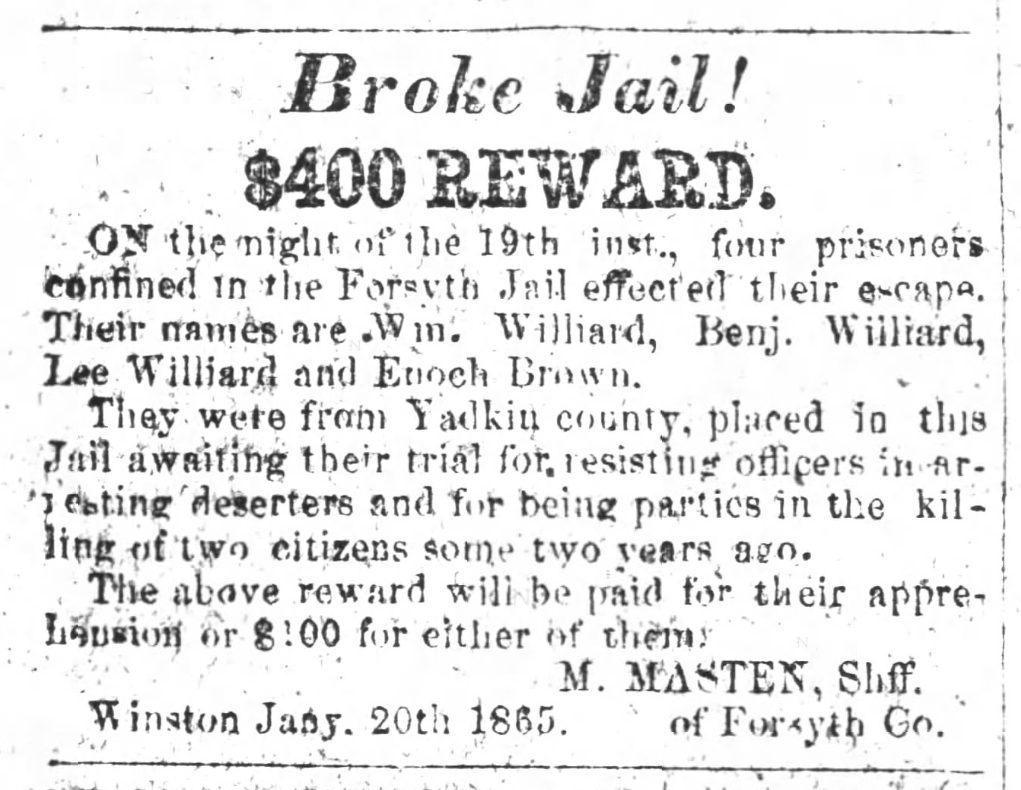
At that point, Elkanah Willard was sent to the Morganton jail, from which he escaped on his own. And his brothers were sent to the Forsyth County jail, from which a sister helped them make a daring escape.

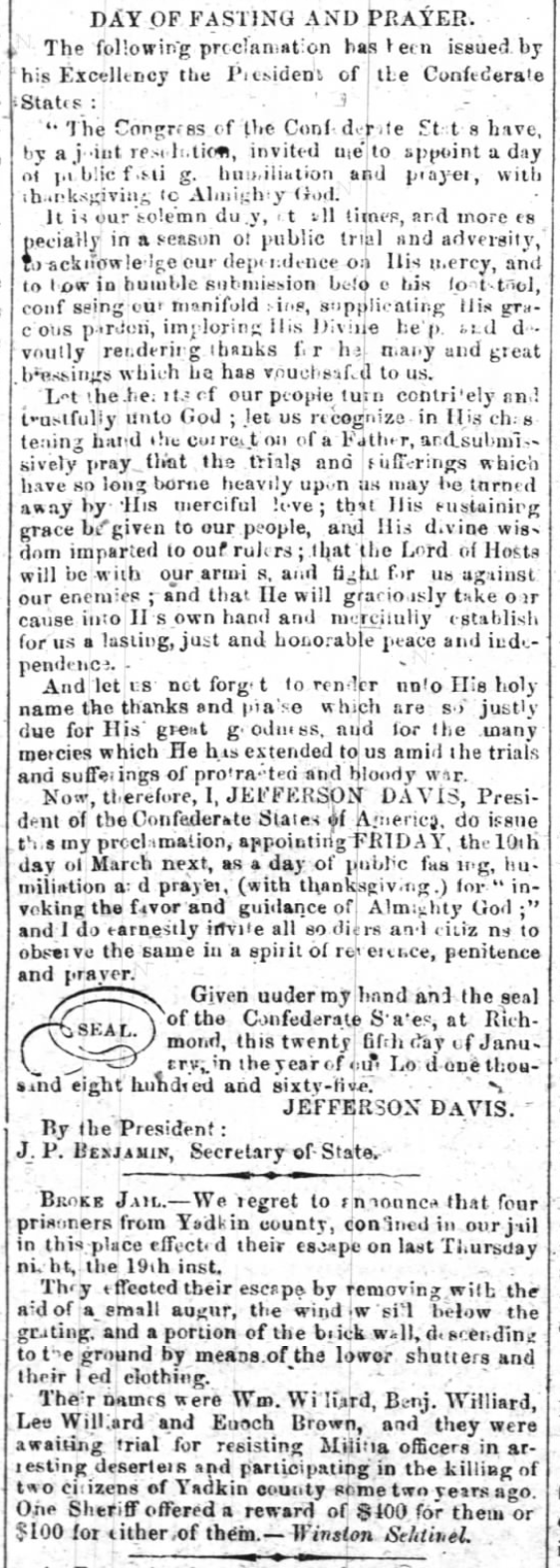
The report about that jail break by the Winston Sentinel newspaper in Winston, North Carolina, was republished in the Daily Conservative newspaper in Raleigh on January 31, 1865. As seen above and to the right, it appeared right below a call for prayer and thanksgiving in a proclamation by Jefferson Davis, President of the Confederate States of America. Here’s a 1906 account of this final jail break story:

The last place [William, Benjamin, and Lee Willard] broke jail was Winston [in Forsyth County, North Carolina]. A sister of the Willard boys secreted an auger and a chisel upon her person, left her home in Yadkin county and went to Winston and after undergoing a rigid examination by the jailor, she was permitted to go up stairs to see her brothers. When she left the jail she left the auger and chisel with them. With the auger and chisel, they bored and cut out of the jail and made good their escape, and avoided being shot or hanged, as a detachment of state militia had been ordered there to take them out and hang or shoot them, and arrived the day after they escaped.

Soon after this the welcome word “peace” was heralded from Florida to California, and from the Atlantic to the Pacific Ocean. And they like thousands of others, at the close of the war, returned to their shattered homes penniless. All indictments against them was nole prosceivied [sic].

In other words, the murder case involving William, Benjamin, and Lee Willard and the other 11 men who had been at the Bond Schoolhouse during the shootout with members of the Confederate state militia would not be pursued after the Union army arrived.

Click here to read all of the reflections in this series.

My Slaveholding Ancestor, Part VIII

During the 19th century, almost all of my ancestors lived either in or adjacent to the “Quaker Belt” of the central piedmont of North Carolina. Quakers, Moravians, and Wesleyan Methodists dominated the religious landscape of that region of the Old North State. My great-great-great-grandfather Daniel Hackney, Jr., lived in Chatham County on the eastern side of that region. He enslaved 14 human beings and had been a pro-slavery Unionist as a member of the General Assembly of North Carolina during the 1840s and 1850s. He retained his political identity as “a constitutional Union man” until President Lincoln requested troops to suppress the rebellion in South Carolina and the rest of the Lower South. Hackney and most of the conservative, pro-slavery Unionists in North Carolina, then became reluctant supporters of secession, which became a reality on May 20, 1861. Hackney served as an officer in the Home Guard.

Even before secession was official, Hackney joined others for a “grand rally” on May 18, 1861, to raise up volunteers in Chatham County for what would become Company E, 26th Regiment, North Carolina Infantry. Here’s how that event was described in a historical sketch written sometime before March, 1863, and republished in the Chatham Record newspaper in Pittsboro, North Carolina, on September 15, 1915:

The day came and with it a large assembly of gentlemen and ladies anxious to join the company or to persuade the hesitating to do so. Speeches were made by William P. Taylor, S.S. Carter, Daniel Hackney, and William G. Headen, encouraging the young men to rally to the call of their country and take up arms against the usurpations of a tyrant as their ancestors did in the memorable struggle of 1776.

In the western half of the Quaker Belt, however, my ancestors in Forsyth County and some of the counties that surrounded it were less enthusiastic about the political situation that had emerged. More of my ancestors are buried in God’s Acre, which is how Moravians from Germany referred to their graveyards, at Friedland Moravian Church in Forsyth County than anywhere else. Five of them belonged to the Friedland Society when it was created in 1771. Another, Tycho Nissen, became its first pastor in 1775, although he’s described as an “Akoluthe,” or non-ordained minister, who led them until they became a congregation in 1780. Nissan moved to Salem in the same county and worked as the gravedigger and headstone engraver for the Salem Congregation (Moravian) and later became the night watchman too.

Friedland Moravian Church shaped the faith of my great-great-grandfather David Williard, his six brothers, and his four sisters. Interestingly, David Williard was born on the Fourth of July, 1823 (exactly 47 years after the signing of the Declaration of Independence). Later in adulthood, he and at least three of his siblings would become members of Primitive Baptist churches. But they all began as Moravians.

All seven Williard brothers fell within the age range that made them subject to America’s first general military draft (i.e., conscription), enacted by the First Congress of the Confederate States of America in the spring of 1862 and expanded in the fall of 1862. Governor Zebulon B. Vance, defending the rights of North Carolina, objected strenuously to this law that seemed to contradict a major principle of the rebellion. The Federal government followed suit with a national conscription act in 1863, resulting in draft riots and racial violence that same year in New York City.

The expansion of the Confederate conscription law in the fall of 1862 not only extended the age range for enrollment but also allowed an exemption from the draft for one slaveholder or one overseer on each plantation that had 20 or more able-bodied enslaved individuals. In North Carolina, that provision applied to the elite planter class, to which my great-great-great-grandfather Daniel Hackney, Jr., didn’t even belong with 14 enslaved people.

One can easily imagine how that made the yeoman farmers of the central piedmont feel. Owning either few or no slaves, their religious convictions did not naturally support pro-slavery opinions (which is not to say that most of them were “radical” abolitionists). Some of them became reluctant secessionists like Hackney after President Lincoln’s call for troops. However, many were either passively or actively resistant to a war that would be fought by the poor for the benefit of the rich.

David Williard, the oldest of the brothers, and William Williard, the youngest, were both privates in Company A, 10th Battalion, North Carolina Heavy Artillery. Alvarius and Joseph Williard were both privates in Company K, 21st Regiment, North Carolina Infantry. Yancey and Jacob Williard were both privates in Company A, 42nd Regiment, North Carolina Infantry. I’m not sure how the seventh brother, Pinkney Williard, was affected by the draft. He might have evaded it, had a medical condition, or served under a different first name. Certain occupations were exempt, but not farmers like him.

Like many conscripts from North Carolina, Joseph Williard deserted on December 26, 1864, with “one gun & accoutrements” valued at $65.23. Yancey Williard deserted in the summer of 1864, but he returned in September under an amnesty program by the Governor of North Carolina.

In spite of that, Yancey Williard seems to be my only relative whose headstone has Confederate references, with the name of his military unit and an engraving of the Confederate battle flag, which would become infamous in the 1960s as a symbol of white supremacist ideology and opposition to racial desegregation.

Yancey Williard’s name appears in a list of soldiers that was published in the Daily Conservative newspaper in Raleigh, North Carolina, on January 20, 1865. It was to inform their loved ones that their company had been captured during the First Battle of Fort Fisher near Wilmington, North Carolina. To be more precise, finding themselves outgunned by the Union navy and separated from the rest of their regiment, they surrendered to Union forces under a white flag of truce on the afternoon of Sunday, December 25, 1864. Earlier, during the stillness before sunrise on that Christmas Day, a surgeon aboard the Union vessel Ben de Ford named David W. Hodgekins wrote these grief-laden words:

How sadly we have fallen that the anniversary of the day of the birth of Jesus Christ, who came to declare peace on earth and good will to men, should be spent in endeavors to take the lives of our fellow creatures in war. The Sabbath we are commanded to keep holy [is] desecrated to gratify men’s wild ambitions. [That we wage war on] this Sabbath . . . seems more than desecration.

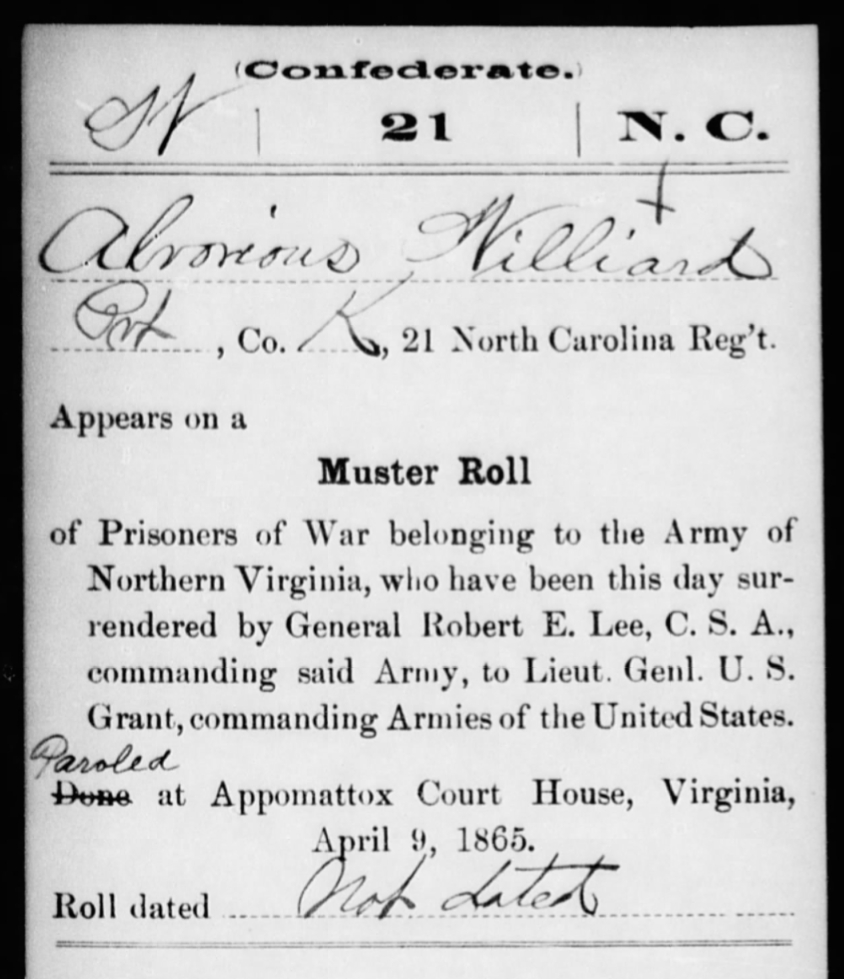
The other four Williard privates seem to have endured longer, although two of them were sick for long periods of time during 1864. David Williard suffered from chronic dysentery for at least six months, while Jacob Williard spent at least nine months in various military hospitals. But it was Alvarius Williard who would become a witness to history at Appomattox Court House in Virginia on April 9, 1865, when the Army of Northern Virginia was surrendered by General Robert E. Lee.

I’ll never be able to know the degree to which these Williards were relieved that the fighting into which they had been pressed came to an end. I’d like to think at least a few of them were kindred spirits with other individuals from the Quaker Belt who were drafted, served, and remained Unionists in their hearts under circumstances beyond their control. I do know, however, that these Williards had cousins who resisted the rebellion actively on the homefront, which will be the subject of my next reflection in this series because the choices they made stand in direct opposition to the choices of my great-great-great-grandfather Daniel Hackney, Jr.

Had those cousins lived in the same county as Hackney, 3rd lieutenant in Chatham County’s Home Guard, they might have killed each other. Each one would have been viewed as a patriot or a terrorist, depending on who would have described them.

The following editorial that was published in the Weekly Confederate newspaper in Raleigh on July 27, 1864, refers to those cousins and others as tories, outlaws, deserters, and murderers. The cousins were among those who had been arrested “for killing an officer of the law,” those who broke them out of jail, and those who tried to reach Union territory in Tennessee. The editorial also decries the political opinions of William Holden, who was the editor of the North Carolina Standard newspaper in Raleigh and would run unsuccessfully as a “peace candidate” against Governor Zebulon Vance in 1864. Lastly, it connects the actions of those cousins and others with a secret brotherhood known as the H.O.A. or Heroes of America. That sounds completely made up, but it was a real organization that worked hard against the Confederate government’s activities in North Carolina. While I don’t know if those cousins of mine belonged to the H.O.A., this editorial testifies to the fear its name invoked:

Click here to read all of the reflections in this series.

My Slaveholding Ancestor, Part VII

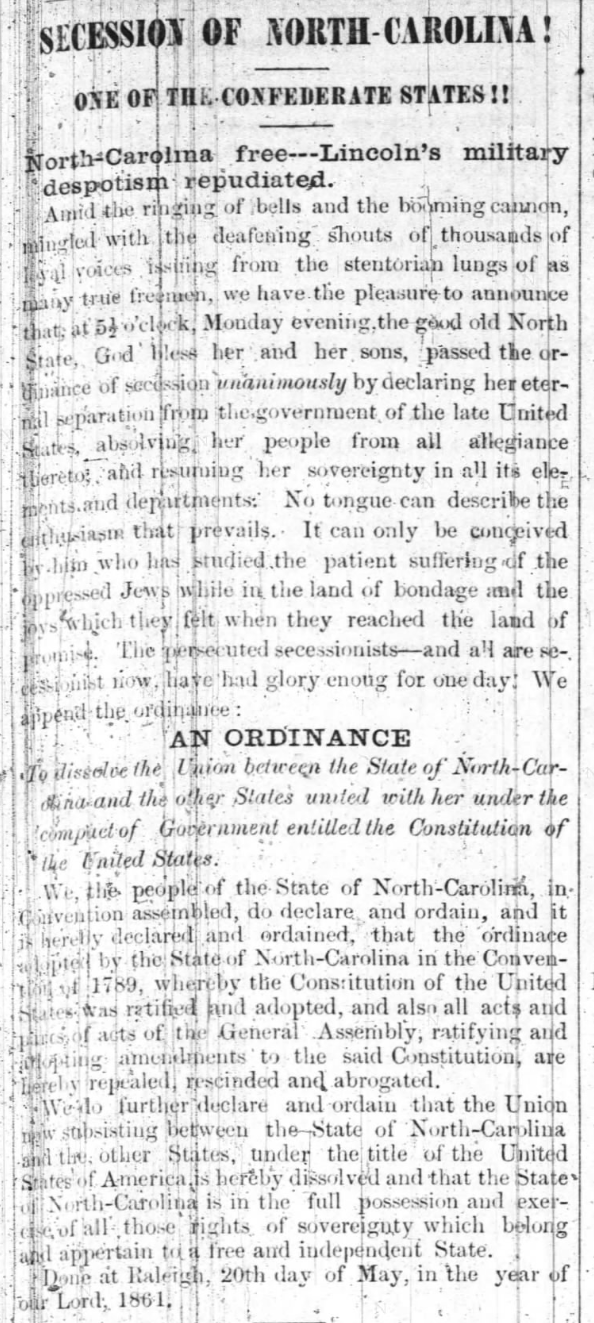
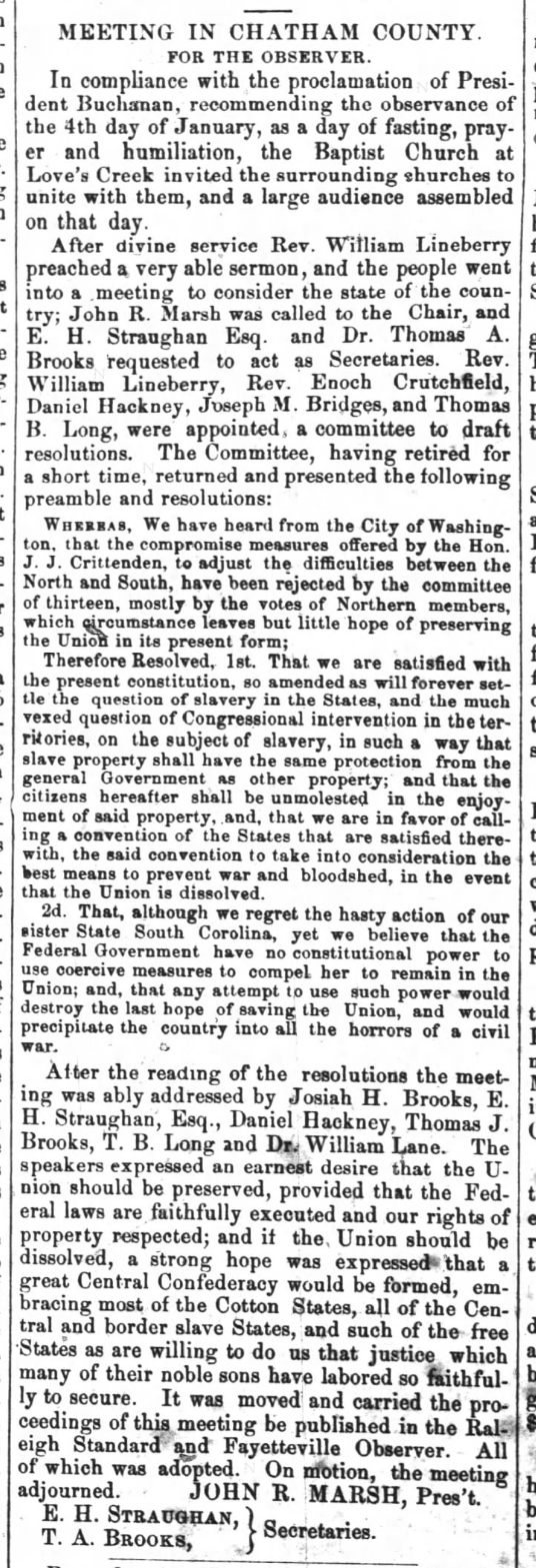
Even before a convention of the people of North Carolina passed an ordinance of secession on the first day that it convened, May 20, 1861, preparations were being made for war. In the previous month, for example, the Governor of North Carolina had ordered the seizure of all Federal property in the state. The General Assembly, on May 2, 1861, made it illegal to administer to state officials “any oath or affirmation to support the constitution of the United States.” And on April 29, 1861, my great-great-great-grandfather Daniel Hackney, Jr., was asked to chair a meeting for the purpose of establishing a “Home Guard” for Chatham County, where he lived. His report about that and another meeting several days later was published on May 22, 1861, in the same issue of Raleigh’s State Journal newspaper that announced the passage of secession.

Hackney and three others were appointed to visit Raleigh for a conversation with the governor about this company, which was being formed by those too old for or legally excused from service in “the regular army.” Hackney was elected 3rd lieutenant of the company, and together with the others:

The company pledged themselves, by resolution, to protect the peace and security of the District, and to look to the interest of those who may volunteer in the service of their country, and especially to take care of their wives and children. . . . The company by resolutions, pledged their services, their fortunes, their honors, and their lives to protect the institutions, and the civil and religious freedom of their native land.

On the same page of the State Journal that Hackney’s report appeared, there was a summary of a report from the Southern Baptist Convention. The newspaper noted the importance of that document, which “approves of the Southern Confederacy,”  as “an expression of sentiment from the largest religious denomination in the country.” It goes on to state that “[the report] will form a bright spot in their history, and be an honor to them for all generations to come.” But that was a false prophecy.

The Southern Baptist Convention had been formed in 1845 when white Baptists in the South withdrew fellowship from Baptists in the North after a slave-owner had been forbidden from becoming a missionary. 150 years later, the “messengers” of the Southern Baptist Convention, assembled in Atlanta, Georgia, acknowledged that historical reality, apologized for their failure to support the 1960s Civil Rights Movement, and stated that they “lament and repudiate historic acts of evil such as slavery from which we continue to reap a bitter harvest, and . . . recognize that the racism which yet plagues our culture today is inextricably tied to the past.”

Similar tensions and strained relationships emerged in other traditions too.

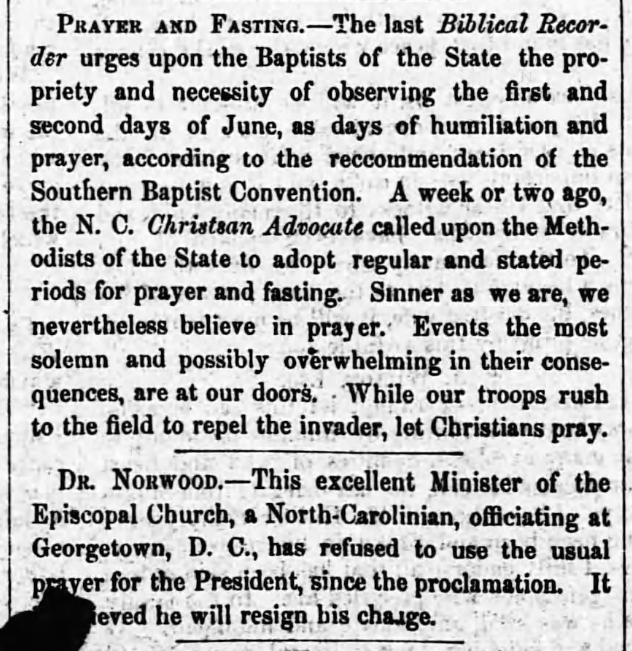
As noted in the May 29, 1861, issue of the North Carolina Standard newspaper, the Rev. Dr. William Norwood, Rector of Christ Church (Episcopal) in Georgetown in the District of Columbia, refused to allow the prayer for “the President of the United States and all in Civil Authority” to be read in worship for his congregation. Like the rest of his colleagues, Dr. Norwood, a native North Carolinian, had received explicit instructions from his bishop to continue to use that prayer and been warned that failure to do so would be in “willful violation of his ordination vow.” Later that same year, he resigned as the Rector of Christ Church and moved to Richmond, Virginia.

Even the Moravians in North Carolina, who were collectively and culturally further removed from the centers of power than both Southern Baptists and Episcopalians, wrestled with politics and prayer. The records of the Board of Elders for the Salem Congregation (Moravian) in Salem (now Winston-Salem) include this description of a discussion on April 17, 1861, about praying for the President of the United States:

The prayer for the President and the Union in our litany was spoken of. For a considerable time it was prayed every Sunday, and its repeated omission of late has been remarked upon. The Board did not come to a determination whether or not it should be regularly used under the circumstances.

Like Salem, Bethania was another Moravian town in North Carolina. And like other ordained ministers in this Christian tradition with German roots, the pastor of the Bethania congregation kept detailed church records, including a congregational diary. The Rev. Jacob F. Siewers’ last entry in that diary for 1860 refers to a worship service on January 31 with lots of hymn singing and a simple meal together called a lovefeast. It was a custom to gather in the church on New Year’s Eve for that service in order to enter the New Year with prayer. He concludes the entry with his own prayer, which is a heartbreaking plea to God for mercy in the coming storm of 1861:

Cloudy and miserable under foot. . . . About 8 P.M. we had the lovefeast at Bethania; there were several pieces sung by the choir. In spite of the high water and miserable roads there was quite a number in attendance. . . . After 12 a prayer was offered, and the Text of New Year’s Day read. Thus closed this eventful year, with heavy clouds lowering around the destiny of our Beloved Country. May God, our God in Mercy spare us from the fearful results of Disunion and Civil War, and cement us again in peaceful Brotherhood, and Christian Bonds as a nation.

The storm of violence, of course, did eventually appear on the horizon, beginning with the first major battle of the Civil War in Virginia in July of that New Year. What it revealed, however, were not only divisions between North and South but also between the Confederate government of North Carolina and the administration of Jefferson Davis, President of the Confederate States of America, and between North Carolinians loyal to that Confederate government in Raleigh and those who resisted it to protect their loved ones and their livelihoods.

That tension between citizens left behind in their communities and the Home Guard, which supposedly existed to protect them, was very high in the “Quaker Belt” of the central piedmont, where Quakers, Moravians, and Wesleyan Methodists dominated the religious landscape, where I was raised, and where most of my ancestors lived in the Old North State.

And they lived on both sides of that divide. While my great-great-great-grandfather served as an officer in the Home Guard for Chatham County, I have other ancestors who were born to Moravian parents in Forsyth County and were drafted as enlisted soldiers in “the regular army.”  But there are clues this was not their war, and their cousins would take that disaffection with rebellion to another level of resistance.

Click here to read all of the reflections in this series.

My Slaveholding Ancestor, Part VI

On April 12, 1861, South Carolina artillery fired on Fort Sumter, which was surrendered the next day. On April 15, 1861, President Abraham Lincoln asked for 75,000 troops collectively from states that remained loyal to the Union to suppress the rebellion. The Governor of North Carolina, John Ellis, refused to send any troops for what he envisioned as a military invasion. In his response to the U.S. Secretary of War, Governor Ellis described the President’s request as a “violation of the Constitution and a gross usurpation of power.” On April 17, 1861, he issued his own proclamation, calling for the General Assembly of North Carolina to meet in a special session on May 1, 1861, for the purpose of  “[united] action in defense of the sovereignty of North Carolina.” Governor Ellis also ordered the seizure of all Federal property in the state.

On the first day of that special session, legislation was passed to hold an election on May 13, 1861, to select 120 delegates to a convention of the people of North Carolina. Unlike the earlier vote in March, this was not about whether to hold a convention but only about whom to send. The General Assembly had already made the decision on behalf of the people that the convention would meet in Raleigh on May 20, 1861. Furthermore, there would be no restrictions on its scope and no popular referendum on its decisions. The mistakes of the past wouldn’t be repeated this time.

Above and to the right is a partial list of counties in North Carolina and the delegates from those counties who were elected to serve at that convention. The list was published in Raleigh on the front page of the North Carolina Standard newspaper on May 22, 1861. In several places, the names of the entire slate are given along with the actual vote count, including the results from Chatham County.

That’s where my great-great-great-grandfather Daniel Hackney, Jr., a former state politician and an enslaver of 14 human beings, lived. Note that his name appears on the list of eight candidates in Chatham County. Three of those candidates were elected as delegates. Hackney came in sixth. Also on the front page that day was a defense of “the old Union men,” like Hackney, “who exhausted all honorable means to save the Union.”

The delegates who were elected to that convention enslaved an average of 30.5 people each and came with opinions that had been shaped by the President’s request for troops. More than half of them belonged to the elite planter class based on the total number of people they enslaved. The convention voted unanimously to secede from the Union on the first day it convened, May 20, 1861. But that is not to say that everyone in the room was equally enthusiastic about that decision. The editor of the North Carolina Standard was there as a delegate and later recalled the scene in this way:

I remember well that when the act of Secession was consummated the body looked like a sea, partly in storm, partly calm, the Secessionists shouting and throwing up their hats and rejoicing, and the Conservatives sitting quietly, calm, and depressed.

My great-great-great-grandfather would have been in the latter group if he had been elected as a delegate. But it’s important to remember the embarrassing truth that he and most of the other slaveholding, pro-slavery Unionists were only reluctant secessionists because they believed it would eventually lead to the destruction of the institution of slavery. They, of course, were right about that. Yet they would not remain in the Union if it required them to bear arms against South Carolinians.

One of those Unionists-turned-secessionists was Zebulon Vance, who would later become the wartime Governor of North Carolina. In some of his correspondence before he had concluded his term as a U.S. Representative, he wrote that it would be suicidal for North Carolina and the other states of the Upper South (i.e., Delaware, Kentucky, Tennessee, Maryland, Virginia, Arkansas, and Missouri) to join forces with the Lower South. Nevertheless, that’s exactly what half of them did. Listed in order of secession, those four states were Virginia, Arkansas, Tennessee, and North Carolina.[1] Zeb Vance’s private fears, shared by many, would prove to be prophetic.

This is how secession was announced in Raleigh’s State Journal newspaper on May 22, 1861, including a sick and twisted use of the biblical story of the Exodus (i.e., the suffering of the children of Israel in bondage in Egypt, their deliverance by the hand of God, and their arrival in the Promised Land) to describe the imagined suffering of secessionists and their liberation in this moment. There is no mention, of course, of the enslaved Africans who were actually in bondage and comprised 33% of the total population of North Carolina, according to the 1860 United States Federal Census:

Click here to read all of the reflections in this series.

BACK TO POST Yes, I am aware of the debate over different ways to order this list. North Carolina had the last state convention to pass an ordinance of secession on May 20, 1861, while the earlier ordinances passed in Virginia and Tennessee were ratified by popular referendums in each of those states on May 23 and June 8, 1861, respectively.

My Slaveholding Ancestor, Part V

On February 28, 1861, there was a state-wide referendum in North Carolina on whether to hold a secession convention and, in the event it was held, the election of delegates for that convention. This was a limited poll, of course, in which the only voters were white male taxpayers.

At the end of the day, those particular men narrowly defeated secessionism by a vote of 47,323 to 46,672. Unionist support, however, was actually stronger than those numbers suggest. That’s because there were also Unionists who voted in favor of holding that convention for the purpose of sending Unionist delegates there to control it. Out of 120 total seats at the convention, Unionist delegates would have had about 80 of them. Most of these Unionists were like my great-great-great-grandfather Daniel Hackney, Jr., who was an as-it-was-with-slavery Unionist, not an as-it-might-be-without-slavery Unionist. The North Carolina Standard newspaper described Hackney, a former state politician, as “a constitutional Union man” in a report about a Union meeting that was held in Chatham County on December 27, 1860.

The ten counties listed above and to the right are part of the election results that were published in the North Carolina Standard on March 6, 1861. Chatham County, where Hackney lived, elected three Unionist delegates and overwhelmingly opposed holding a convention by a vote of 1795-283. (“Chatham has covered herself with glory.”) Forsyth County, where I was raised, elected two Unionist delegates who ran unopposed and overwhelmingly rejected the convention too. Alamance County, where my mother grew up, also elected two Unionist delegates and voted down the convention. (“Three cheers for Alamance for electing straight out Union delegates!”) And the same story was repeated in Guilford County, where my father was raised, with the election of three Unionist delegates, 2771 votes against holding a convention, and only 113 votes for it. Five of those counties are in the “Quaker Belt” of the central piedmont, where Quakers, Moravians, and Wesleyan Methodists would provide fertile soil for disaffection with a pro-slavery rebellion to take root.

Some of the other counties listed there, where the convention vote was much closer, are further east, near the coast. Generally speaking, that tracked with popular support for secession across the Old North State, with less enthusiasm the further west one traveled (i.e., toward the Blue Ridge Mountains) and more enthusiasm the further east one traveled (i.e., toward the “inner banks” along the coastal sounds).

This pro-Union verse, sung to the tune of Dixie’s Land, was published in the North Carolina Standard on February 6, 1861. It reflects a mood that remained popular as late as April 3, 1861, when the following editorial appeared in the same newspaper, together with other reminders that “the disunionists were voted down on the 28th of February” and that Unionists like my great-great-great-grandfather were “not unsound on the question of slavery.” Alas, “not unsound” here means pro-slavery:

North Carolina will not secede from the Union for existing causes. Nearly all the Union candidates in this State advocated a Convention; if they had opposed it, it would have been voted down by 30,000 majority. We state this as one of the strongest evidences that the State is not disposed at this time to secede. It will not do to say that the people of North Carolina are submissionists. They are just as brave as other people, and because they are, they are not ready to fight shadows. . . .

We repeat, North Carolina will not secede. Virginia will not secede. The late action of her Convention shows that she is watching and waiting. She sees no good cause just now to join the war dance of secession. Our disunion friends may as well hang up their fiddles. The people will keep step to no tune of their playing.

Nine days after those words were published, on April 12, 1861, South Carolina batteries opened fire on the Federal garrison at Fort Sumter in Charleston Harbor. The fort was surrendered the next day. Then, on April 15, 1861,  President Abraham Lincoln issued a proclamation asking for 75,000 troops collectively from the states that remained loyal to the Union for the purpose of suppressing this rebellion by South Carolina and the other states of the Lower South. Listed in order of secession, those six states were Mississippi, Florida, Alabama, Georgia, Louisiana, and Texas.

Click here to read all of the reflections in this series.

My Slaveholding Ancestor, Part IV

My great-great-great-grandfather Daniel Hackney, Jr., was first elected to the House of Commons in North Carolina’s General Assembly in 1844 as a member of the Whig Party from Chatham County. He served four two-year terms in a row, through 1851. After the dissolution of the Whig Party in the 1850s, he became a Democrat and ran for the same office in the same county on the anti-Know Nothing ticket in 1856. He served one two-year term with that new political identity. One letter to the editor in The North Carolina Standard newspaper, referring to Hackney’s opinions about the 1856 presidential election, claimed that he believed old-line Whigs and Democrats “ought to unite now to save the country by sustaining that candidate who would most probably beat the black Republican ticket.”

“Black Republican” was a disparaging term used to highlight the anti-slavery views of the Republican Party, which had only been formed two years earlier in 1854. The two-part article on the right from The North Carolina Standard newspaper describes a Union meeting that convened in Chatham County on December 15, 1860, and then again on December 27, 1860.

Many of the people who attended similar meetings in the Old North State were like Hackney. He was an as-it-was-with-slavery Unionist rather than an as-it-might-be-without-slavery Unionist. They believed the best path for protecting the institution of slavery was to stay in the Union, and that secession would likely result in slavery’s destruction. Although Hackney no longer held a seat in the General Assembly and didn’t make a formal speech at either of these meetings in Chatham County, he “was called out” to offer some remarks at the second gathering with the larger crowd and “explained his position as a constitutional Union man.”

The resolutions that were passed at that second meeting include a lot of highly qualified language. There is much concern expressed at the end about equal rights, not for individuals but for states. While the perception that states’ rights were being trampled upon fueled these debates, the fifth resolve hints at the real source of the anxiety: “That our Legislature should pass such strong retaliatory laws against those States which have attempted to nullify the fugitive slave laws, as in their wisdom may seem right and proper and in accordance with the Constitution of the United States.”

That becomes even clearer on January 4, 1861, at a meeting in Chatham County that was initially convened in response to President James Buchanan’s call for “a day of fasting, prayer and humiliation.” The President intended that as a way to calm the storm of unrest in the North and in the South following South Carolina’s ordinance of secession, which was adopted on December 20, 1860.

The meeting took place at Love’s Creek Baptist Church, where Hackney had served as a deacon long before he was first elected to public office. After the prayer service, Hackney, two ordained ministers, and two other men “were appointed a committee to draft resolutions.” The Fayetteville Observer newspaper noted that their work didn’t take very long:

Although Hackney and others spoke of their desire to preserve the Union, that was only true “provided that the Federal laws are faithfully executed and [their] rights of property respected.” As the first resolve plainly states, that property included enslaved human beings, and the will of the people gathered inside that Baptist church was that “citizens hereafter shall be unmolested in the enjoyment of said property.” My great-great-great-grandfather enslaved 14 people at the time he helped to write those words. That is a difficult but necessary truth to acknowledge. This really happened, and despite all of the rhetoric about states’ rights as the primary Southern issue, protecting the institution of slavery was the motive behind it.

North Carolina did not secede from the Union until May 20, 1861. The larger political story that led to that, including what happened on the ground in Chatham County, warrants its own reflection. It’s a story that’s not as simple as one might imagine it to be.

Unionists, both pro-slavery and not pro-slavery, won a state-wide victory in February of 1861 that, ironically, almost certainly aided the secessionist movement in the long run. Those on the losing side would make sure that next time there would be no popular referendum about whether to hold a secession convention and no popular referendum on its decision. When secession did become a reality, most “conservative” pro-slavery Unionists like my great-great-great-grandfather didn’t resist it. They joined it.

Click here to read all of the reflections in this series.